Tuesday, June 14, 2011

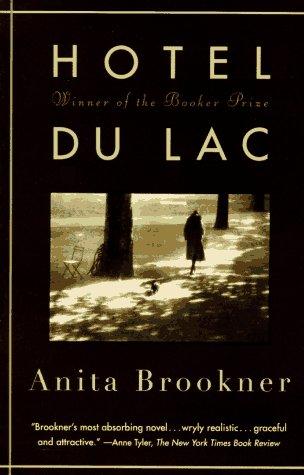
Hotel du Lac

Today we said goodbye to Cheryl, a dynamic and delightful contributor to our discussions. She's off to a new adventure and we wish her the best, but man on man, will we miss her.

Joanne had been so taken by our April book, South of Broad, and by Conroy's Charleston that she told a friend that it made her want to go there. Today she told us that she and her friend did just that and it was even better than she could have imagined. She said she was surprised that the city was so cosmopolitan. After Cheryl's sad news (the movers were packing her house at that very moment), it was a lovely change of pace. Diana teased her and asked if she had booked her tickets for France yet.

Carolyn told us about a Nancy Pearl podcast she had listened to where Nancy talked about the elements that make a good book club book: the book receives mixed reviews from the group, the protagonist makes a decision and the book doesn't wind up in a neat ending.

We had all of those things in Hotel du Lac. Joanne started by saying she did not like the book, found the story listless and the characters insipid. She qualified her comment by saying she was simultaneously reading Jeanette Walls' latest which was engaging and engrossing. Mary on the other hand had loved it so much that she went back and read it a second time.

We were in total agreement that the prose was fantastic and if nothing else we read on because we were engaged by her "turn of a phrase" and the unexpected revelations that she sprinkled throughout as she uncovered the story. I'm sure the room painted "the colour of over-cooked veal" will stay with me for a very long time. Cheryl said that it was a slow read for her, but she agreed with Mary that she had enjoyed it, though she wouldn't have had it been any longer. Wilma thought it more of a back story to another story.

We were left hanging on whether she would go back to writing romance novels. Connie said she thought the hint of a change (rather than a promise of a new future) in her stay at the hotel was probably realistic to life. We also weren't sure what kinds of friends her friends were. Edith didn't appear to have any deep and trusting relationships, and she knew David was cooling his heels. We absolutely couldn't explain why she had messaged David by telegram, not letter, that she was not "coming home" but "returning." Why not Penelope? She put her on the plane, for crying out loud.

We also talked about the timing of the story, published in 1984. With so many couples living together and raising families outside of marriage, we felt the story would not play in today's values. We kept laughing that her gaffe of leaving Geoffry Long at the altar was so egregious that it required her taking a leave of absence. We loved the hotel, which was every bit a character as it's occupants.

Another question we toyed with was why Edith was willing to be the other woman with David and not with Neville. As Cheryl said - she loved David, but at the time of Neville's proposal, she knew David was moving on. She could have had the life of her choosing with Neville and wanted for nothing. Instead, she chose to go home with a manuscript that she wouldn't finish to her garden. Whatever her image was for her future, she kept it to herself.

Tuesday, May 10, 2011

Standing in the Rainbow

I opened the discussion today by saying that I had spent some time this morning reading Amazon reviews of this book. I was surprised by those who had rated it with one star, and one reader pondered if she were reading the same book as those rating it with five-stars. Wilma said she would like to know what age those one-star readers were. Good question! Our group spent an hour talking about the things we loved about this book, but we are pretty much of a common age. Amazon critics faulted her failure to develop the characters she had introduced in her earlier book, Welcome to the World, Baby Girl, but it wasn't their story.

I asked whose story they thought this book was and without hesitation, Lucy responded - Elmwood Springs! As a character, the town was fully developed through her large cast. We loved the many famous names like Bess Truman, Eleanor Roosevelt and Elvis Presley that she threaded throughout the narrative. We also noted that in spite of so many characters and interactions, the story wasn't confusing or difficult to follow. We found ample opportunities to laugh and cry.

The fifty years this book spans starts with a town where everyone stays together and grows old together, where the oldies cluster around Ed's barbershop for his "special" eggnog, seeing each other as aged versions of the youngsters they were, and progresses to where one by one, they participate in an American diaspora and move away. I said that as I got closer to the end I started thinking of Steve Miller's song, Fly Like an Eagle, especially the phrase, "Time keeps on slippin', slippin', slippin' into the future" When Normal and Macky bought a unit sight unseen in a Florida retirement community, I felt so much of Flagg's thoughts were delivered through Macky. "Life as he had known it was all over." "Macky wandered around the complex. Not only was he in a different state, he was in a different world and he was lost. " Many of our parents have been there, and some of us have or will be, perhaps even Flagg herself.

Which reminds me, Cheryl dropped the bomb that her husband has accepted a job and they will be moving soon. It struck me as an illustration of what Flagg had written; could have been right out of the book. And interestingly, as Wilma shared how they came to Reno five years ago, after her husband's illness, she said she would move wherever he wanted and he chose here. Is that Norma and Macky, or what?!

We were in agreement that the death of Neighbor Dorothy's was powerfully and succinctly delivered though the radio announcement. Her radio show was yet another character and through it we met Mother Smith by her organ playing and Dorothy's repeating her comments into the mic, comments we only heard through Dorothy.

At the end of the discussion, Lucy asked who our favorite character was. She is our youngest member and we thought it interesting that her favorite character was Betty Ray, one of the youngest characters. But then, it didn't matter whose name was mentioned, they were all favorites. Poor Tot was great and we laughed at her "nervous breakdown." I had missed that the man she married was the Fowler chicken guy who gave Bobby his job and was glad to get that piece filled in and the "poor" removed from Tot.

We adored Macky and Norma, who in spite of asking Macky to shoot if she ever became her mother, did become her mother. And how can you not laugh at a woman examining herself in the mirror in her panties and bra, asks her husband if her body makes her look fat. We even laughed when the boat blew up. Cheryl roared when she recalled that it was perceived as a comet falling from the sky.

As for the title, Mary said she thought that many were characters were "standing in the rainbow" but didn't know it when they were there, including Bobby and Hamm. Bobby recovered his direction and Hamm "went over to the dark side," as Carolyn said and never seemed to realize it.

We loved the role of women's influence that Flagg inserted, starting with Mother Smith's participation in the suffragette movement, to Betty Raye running for governor and Dorothy's mention of her support on the radio. The support started as a trickle but turned the tide.

Several mentioned that they had either reread Welcome to the World Baby Girl or plan to as well as the sequel with Normal and Macky, I Still Dream about You. After the disappointment of reading those panned reviews this morning, I have to say that I am a fan, not a critic of Fannie Flagg and I was happy to be in good company today.

Tuesday, April 12, 2011

South of Broad

We had a wonderful group today to talk about Pat Conroy's latest book. We universally agreed that Prince of Tides, it is not. Mary broke the ice by asking if she was the only one who hadn't loved the book. She said she would never have read past page 40, were it not for book club, and we all said that we have all finished books for exactly the same reason. It was a very good question, nevertheless. Did we love the book?

I think we agreed that we found it an easy book to blow through, and like Cheryl said, that might have been in part because we've had a long series of dark difficult books. Luci and Maureen, who have lived in the South, completely enjoyed the book, and I think to a person we all wanted to visit Leo's Charleston. We felt Conroy's love of the South was probably the most genuine tone of the book. We were critical of elements we found stereotypical, and we also were critical of the themes that always seem to be present in a Conroy novel: suicide, the Catholic Church, marital infidelity, homosexuality, detached parents, and on. This was the first for a loving father, however. I questioned if that relationship were genuine, and Luci assured me by example that it is.

Nun/Mom Lindsey seemed unable to love Leo like her lost beloved Steve (I just realized that nun and mom are palindromes) and we felt she probably should have remained a nun. Joanne asked if it bothered anyone that Lindsey spontaneously decided to leave her order with one day's notice after reading Jasper's letters following eleven years of dedicated service. (It bothered me, for one.) All of us struggled with Lindsey. Mary was very frustrated by her hateful treatment of Sheba. The day she assigned Leo to bake cookies for the twins, greet the orphans and then report for basketball practice to the new Black coach - we talked a lot about it and were left shaking our heads - why that should have been normal to either one of them.

Perhaps the most emotional discussion was of Trevor and his highly sexualized behavior at such a young age, which only became more so with time. The question was - was Conroy's Trevor stereotypical gay? Kathy felt not so, because her gay employees were model citizens at work and talked like Trevor to each other at the parties she was invited to. Cheryl presented an emotional other side of gay San Francisco in 1985, the time of Trevor's decline. The AIDS epidemic was given a name and a face in about 1982. Many of these young men who had openly engaged in the gay lifestyle had no idea of a time-bomb that was ticking. She was working in San Francisco at the time in the theater district and said that the massive loss of life of these creative and brilliant young men was devastating, so much that she and her friends took turns attending funerals because otherwise it was too overwhelming.

We talked about Sheba and Trevor - survivors of an abusive father and both highly sexualized as a result. Where was the mother Kathy asked? Why did she work up the nerve and money to flee and then give up~ And then we started into the inconsistencies we felt the book held. Luci couldn't buy Chad had visited the hospital every day - out of character in her opinion. Mary said she had never read more contrived dialogue and grew to dread quotation marks. We wondered at Conroy's choice to have all dialogue between friends be to insulting and combative. All dialogues between Leon and Mr. Canon were of that nature, and yet Mr. Canon regarded Leo as the son he never had.

And so it went. We didn't like it a lot, yet we mostly agreed it was an easy page turner. (It's so so so different from any Conroy I've read in the past.) It had all the elements from classic Conroys, just not the construction. And did it really need a serial killer? We all complained that he wound up lose ends without really completing them. He conveniently left the killer locked in a shed during a hurricane, Sheba and Shelba are summarily dispatched, and what happened to Evangeline? We quipped that he reached his requisite 500 pages and so wound it down from there.

Mary felt that he had started a novel in the 1980s and just hadn't gotten around to doing anything with it - he hadn't written anything in a while and his publishers were asking, so he dusted off and resurrected his relic. Carolyn had a different take. His current wife is novelist Cassandra King and he has admitted his jealously over hearing her laugh while she writes. Carolyn postulated that he said as much to her and she said, honey, you can do it too. This is the first Conroy that I can remember laughing at - as unbelievable and contrived as all the sarcastic dialogues were, I laughed. Would you recommend it to a friend?

Tuesday, March 8, 2011

The Poisonwood Bible


We had a rollicking discussion today because, as Cheryl noted, everyone came very well prepared to discuss this complex and difficult book.

Mary asked an interesting question - how many of us read it for the first time and how many reread it? Those who reread it said they enjoyed it more the second time because the first time they were reading for the story and waiting for the other shoe to drop. Several of us said that we didn't actually get to the point of liking the book until over half way. Kathy said she didn't like it at all until the part about the ants and asked how many had actually liked the book in the end. All of us. I can tell you I would never have finished it, were it not for book group. I also know that I will reread it.

We did think that Methuselah was Nathan - a parrot. Kingsolver never gave Nathan his own voice yet he marked everything, even as a parrot. He and Africa absolutely shaped the lives of the Price women. They never left Africa and Africa never left them - I forget who made that point.

In reading it this time, Mary said she felt that each of the characters embodied a characteristic of Africa, and I wish I would have written them down because we agreed with her. We enjoyed the humorous and superficial Rachael who surprised us by creating and running a business. She was a survivor, seeing opportunity in Alexrod whom she was married to "in the Biblical sense." She considered herself a survivor, saying if she were in a burning theater, she'd wedge herself into the crowd, pick up her feet and let them carry her out so she wouldn't get trampled. And how she could turn a phrase - like "feminine tuition" and "I prefer to remain anomalous."

The huge frustration of the book is Nathan's insane inability to care for anything, especially his family, and Orleanna's inability to stand against him and for her girls who are left defenseless and hungry. We talked a little about Kingsolver's choice of four blond children to deliver the message of Africa's hopelessness and if it were so that we'd be forced to care. Would we have felt the same had the four children been Black? We did love the exchange between Brother Fowles and his spirituality and Nathan and his loveless religion.

We had a discussion on the mission itself after Kathy said that the children should have been sent out when they were told to go but then it was through this that we saw the rich life of the Underdowns in town while the Prices were starving. Then we talked about how this also revealed that Nathan was never actually sent on this mission, and was in fact, told not to come. Nathan insisted he was a man who could only tell the truth but in this light, their whole missionary presence was based on a lie.

And then there was the irony of Orleanna having a picture of Ike that she liked to look at, the fatherly American president, and Ike's administration and the CIA who displaced the elected president of Zaire and replaced him with the malleable Mobuto, which in turn turned their world upside down. Anatole's description of Mobuto? He is the one wife belonging to many white men.

Mary had been in the Cameroons with her Peace Corps daughter and felt that Kingsolver has written an accurate and empathetic picture of this continent, and reminded us that it is not a poor continent but it has poor people. The resources are being scavenged by agencies like The Whole Bank. In Leah's words: No other continent has endured such an unspeakably bizarre combination of foreign thievery and foreign goodwill.

Yesterday in thinking about the book, I wrote a note to myself. Who was the Christ figure? I figured with a story of transgression and redemption, there had a be a Christ figure and I assumed it was Anatole. Kareen and Cheryl picked up on that and started tossing thoughts back and forth, finally declaring it to be Ruth May. She was innocent, died young and in the end came back with the message of forgiveness.

It was a hard book to read and I'm glad I had a book group to read it with, because I came away with so much - an emotionally stretching experience. Thanks Cheryl for reading the ending aloud, because I couldn't have done it.

Wednesday, February 9, 2011

Midnight's Children

This will unquestionably be the most unpopular book our group has ever read. I was worried that it would also be the shortest meeting ever because I wasn't sure if anyone would actually come or have read it. We were delighted to be joined by Mary, who was attracted to us by this book selection. She said she had always wanted to read a Salman Rushdie and realized that a book club could be just the ticket. Haven't we said that ourselves?!

Cheryl reminded us that this book was selected as the Booker of Booker Award books. One reviewer said that it's a book of major importance book, the Indian version of A Thousand Years of Solitude. We all agreed that it was very inaccessible to read, that the writing was "obtuse" as one friend had said to me, but also a book we won't forget over time. Carolyn said she was reminded of Water for Chocolate, with all the mythology woven into the story as fact. Jenny said the writing reminded her of Isabelle Allende's works, very mystical. We acknowledged that it's a college curriculum material and an ambitious read.

Mary said that once she committed to read it, she realized that it was easier to read it for stretches of time - not a pick up and put down book. She also mentioned an important point that I had missed. Methwold was the father of Saleem, and hence the origin of blue eyes. We kept guessing at allegory because it was clear that everything was written on more than one level. We thought perhaps Methwold was allegory for the false state of the Raj as he himself was false. The very thing that made him so attractive to all the women was his wonderful hair, parted right down the middle. His last act before leaving his estate was to lift his false hair from his head and fling it away.

The community of the midnight children that congregated in Saleem's head was something we weren't able to get a handle on. Rushie wrote so much about noses, and when Saleem's was finally drained, the community ceased to exist. I'm sure a professor that teaches this book could enlighten us here. And the two - Shiva and Saleem - born at midnight and switched at birth. Who was better off for the switch? Mary Pereira who committed this act thought the poor child raised as rich would have an advantage, but was Saleem indeed advantaged by her act? Didn't living on the streets empower Shiva??

We weren't sure why the children born at the stroke of midnight on the eve of India's statehood received such magical powers and why those born further away from midnight had fewer powers - more allegory that perhaps if we were familiar with Indian history would make sense. Jenny said that she was pleased to learn so much about the history of that area, though it wasn't enough to make her want to finish the last 50 pages. She ceremoniously pulled out her book mark so she could check it back in. We talked for an hour, believe it or not, but we ran out of steam because there were so many unanswered questions.

We all had certain phrases that we shared because the writing had gripped us and we certainly agree that the man can write. We wished he had used fewer words, and so now we've read Salman Rushdie. I don't think any one of us is interested in reading him again. Cheryl kept asking, but who suggested it? Who knows? He won't get suggested again.

We concluded with a fascinating discussion with Diana about living in Fairbanks for 30 years and we were far more animated on that topic.

Tuesday, January 11, 2011

World's Fair

The answer to "how did you like this book" had qualified yeses in response today. Universally, we found the first 100 pages to be slow and seemingly without forward movement, other than through time. Diana read from a review that was critical of this lack of story and pace.

We all agreed that it was a pastiche rather than a developed story like A Tree Grows in Brooklyn. Throughout the hour, we came back to comparisons of these two books. Cheryl said she had compared them while reading. I wish I had thought of it! I thought more of the writings of Anny Tyler.

A New York Times review from 1985 said that this was the most autobiographical of Doctorow's books, and was disappointed that he had tried to combine oral history, memoir and novel all at once. That explained the first 100 pages, and though we found them slow, we still enjoyed them. Kathy said that things hadn't changed dramatically from the time of the book and the time of her growing up in Brooklyn. She thought that the change from her childhood to say, the 1970s was much more dramatic.

The reviewer thought the last 100 pages were "breathtaking." We didn't exactly agree with this dichotomy in structure, but then we're fans, not critics. (That's my daughter's line and I like it.) The reviewer took exception to the "tedious description" of radio and movie serial plots, i.e., The Shadow and Zorro. He said the material was overdone. I would love to know the age of the reviewer. We had so enjoyed the segment on The Shadow, and Cheryl even read it aloud to her husband. Kathy wondered if this book wouldn't be valuable to young people today, revealing the Big Apple on the cusp of world war.

Rose was the helpless housewife and mother of that time. We pondered if she could have had a position of strength if she hadn't take a victim's attitude with Gussie, her mother-in-law. The reviewer took exception with the occasional other first-person voices, like Rose and Donald, but we felt it helped us to see a family that Edgar could not have shown were it completely written in his voice. Kathy liked Dave's interest in current events - he told Edgar that General Motors was getting Americans to pay for roads with tax dollars so we they would buy their cars.

We did like Dave and were disappointed that, with all his promise, he wasn't able to thrive. We especially liked Donald, who as first son, experienced Dave's devotion. We thought that Dave seemed to have tired of his father role by the time Edgar came along.

We all felt as we read through those quiet reminiscent pages that the story would develop into the World War II, the Jewish Question and death, perhaps Donald's in the war. The death apparently was Dave's and we couldn't explain why Doctorow inserted it into the middle of the story in Aunt Frances' voice. If you know the answer, please do tell.

We talked about the choice of title since the actual fair doesn't enter until the final third of the book. It's not until we get to the fair that we are told the fair's theme is "The World of Tomorrow." Edgar seems obsessed with the Trylon and Perisphere, which depicts a city-of-the-future. Edgar remarked that you entered, viewed the minature city of the future and then exited at the same place you entered -was Doctorow inviting us to think of this family tomorrow? Oh, and we really liked Norma, and as Kareen said, she probably had a better life in her shady role than Rose in her proper role.

We wondered if the family had turned a corner with Edgar's prize and free admission to the fair. The family witnesses the symbolic time capsule that is buried for 5,000 years in the future. Dave comments at how inappropriate the items are as a representation of contemporary society. The book concludes with Edgar burying his own time capsule, but with items he sacrifices and are meaningful to him though the ventriloquism book is excluded at that last minute. I asked if this was a fitting end to this book. Cheryl read this from the last paragraph - "My way home headed me into the wind. I put my hands in my pockets and hunched my shoulders and went on."

Friday, December 17, 2010

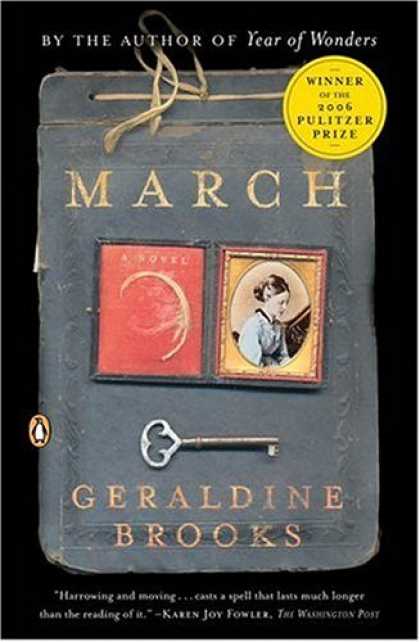
March by Geraldine Brooks

Our poor book was almost eclipsed by the Christmas potluck and all the great food. Discussion was nearly an after thought. And by the way, the extra food that we gave to the staff was just about completely gone by the time I left. I think they loved our potluck as much as we did!

Procrastinating, or perhaps I'm digressing? I came to this discussion having found this one of the difficult and painful books that we have read over the years. I was critical and judgmental of John March and couldn't think of anything good to say about him. My mother used to say, if you can't say anything nice, don't say anything at all. I expected a very short discussion.

Carolyn said that it took her a while to warm up to the book. I asked her how far "a while" was, and she said when she got to Marmee's voice, which was exactly my experience. We talked about March being impractical and struggled with how he took responsibility for everything but his family.

Luci said she thought her perspective might be different if she had read Little Women, and I have agree with her since I haven't read it either. We felt sorry for Marmee. As Grace put into words, she was married to a man who "lives for ideas," which left Marmee to the "practical matters of life." We struggled with his failure to provide for his family's welfare.

We rather dismised March as self-absorbed and it wasn't until after we had eaten, the discussion turned to how March and Marmee viewed the "packages" they had helped deliver, how their daughter was the one who spent time with the young pregnant Negro as a person. I remembered marking a selection from Marmee's voice: "A young Negro boy - are there no end to these people? - opened the door." My question was, what were Marmee's genuine feelings for Negros. Cheryl returned to March's unconditional attitude towards Ethan Canning's freed workers and how he even danced with them all night. We ended up thinking that March wasn't as much self-absorbed as he was heart broken by his inability to save these people that he had come to love.

We found ourselves at a loss to understand how little Marmee and March communicated their inner feelings, in spite of their commitment to their Quaker ideals - that she didn't want him to go to war and he read in her face that she was proud of him for volunteering. We talked a bit about how much of that was typical for the time period and how much was from their faith ideals. We agreed that this book earned it's Pulitzer Prize!

I left feeling much more sympathetic to March and the crossroads he found himself trapped in, and resolved that Little Women will find itself on my night stand very soon.