Tuesday, February 12, 2013

Dovekeepers

We had a little larger group than usual today and all said they enjoyed the book, some more enthusiastically than others.  Some breezed through it but a few of us felt that The Dovekeepers could have benefited from some tightening and perhaps less repetition of the magic, spells and incantations. 

 I wondered where the line was drawn between witchcraft, which was clearly an abomination in the Old Testament, and where the superstition and spells were accepted.  Joanne reminded us that in that time the Kabbalah was used to as a source of explanations, and it had it roots in Jewish mysticism.  As Mary said, either it was God's will, or it was not. 

Kareen is on vacation but wrote - "Funny, usually I can place myself into the book, as one of the characters or at least a bystander.  I couldn't in this book so never got emotionally involved."  She has been to Masada and said that the ramp built by the Romans was spectacular.  "One could tell they they were very determined to get into that fortress." 

We appreciated the tremendous research that Hoffman invested into writing this book, a five-year project.  She led us into the heart of a violent past with the personal and intimate interactions between the characters that would have made it impossible to feel immersed in the history otherwise.

Told in four parts, I think we favored the last one, though I agree with Carolyn that it was maybe too convenient that Shirah was Yael's nursemaid in the beginning.  Jennifer said the same about the ending, when it came to a surprisingly happy-ever-after conclusion .

The final discussion centered around the relationships between the mothers and daughters and why they made the decisions that they did, because secondary to the story of the zealots holed up in Masada is story of the women.  From there we digressed to the complex mother/daughter relationships and really didn't return to the book.  And a good time was had by all :)

Tuesday, January 8, 2013

The Sense of an Ending

One of our first comments today was how pleased we were to find such a short, well-written book.  The other thing we were in universal agreement on was our surprise at the ending.  So much of Tony's introspection was about memory and it's reliability. As one reviewer noted, "Mr. Barnes does an agile job...of unpeeling the onion layers of his hero's life while showing how Tony has sliced and diced his past in order to create a self he can live with. In doing so Mr. Barnes underscores the ways people try to erase or edit their youthful follies and disappointments, converting actual events into anecdotes, and those anecdotes into a narrative."  We were in for a ride.

Carolyn had marked and read this quote from Tony: "We thought we were being mature when we were only being safe.  We imagine we were being responsible but were only being cowardly.  What we called realism turned out to be a way of avoiding things rather than facing them."  We only know Tony through his thoughts:  "What did I know of life, I who had lived so carefully?  Who had neither won or lost, but just let life happen to him?"

Adrian remarked on it first in Old Joe Hunt's class:  “History is that certainty produced at the point where the imperfections of memory meet the inadequacies of documentation."  He seemed to be old beyond his years and we couldn't help question that if when his mother abandonment him, she took his joy with her. I wondered after I got home if his attraction to Mrs. Ford might have been related to the absence and distance of his mom.

Tony's friendship with Adrian was really packed into a short span of time when you stop to think of it.  Adrian died at 22, yet it seems that Tony continued to look up to him:  "He took his own life" is the phrase; but Adrian also took charge of his own life, he took command of it, he took it in his hands - and then out of them."  Robson's suicide note was "Sorry Mum."  Adrian left a missive, yet ironically it appears their reasons for suicide might have been similar.

We spent a great deal of time trying to figure out Veronica.  Had she "suffered damage a long way back" or was that another of Tony's rationalizations?  We realized that we only knew anyone through Tony's eyes so Kathy said she was surprised to read in one review that Veronica was bookish and shy.  Tony showed her to us as aloof and a tease.  We questioned if he were ever in love with her.  He even asked her and she replied, if you have to ask, you weren't.  Then we wondered if he truly ever loved anyone or had friends.  He turned Margaret into a mother figure.  God knows where his mother was since his parents weren't part of his reflections.  Were this read in a college seminar, I'm sure the mother themes would be examined closely.

The first half of the book seemed to be Tony's recollections and rationalizations.  At one point he said, "Learning the new emotions that time brings.  Discovering, for example, that as the witnesses to your life diminish, there is less corroboration, and therefore less certainty, as to what you are or have been."  His musings seemed to substantiate his mediocrity and apathy in everything.  Finally I asked if anyone had liked Tony.  Carolyn and Peggy but said they did.  We were floating on his slightly self-congratulatory cloud when Veronica dropped his spiteful vitriolic letter on him, which changed everything.  It showed just how much of his past he had recreated and changed to make himself comfortable.

When Kathy asked about "blood money" we had to assume that it was somehow related to the letter - it implies buying someone off.  Why did Mrs. Ford leave him the money and the diary?  Peggy said she thought the mother's actions were evil and meant to punish.  We didn't understand why Veronica kept her meetings with Tony as the end unraveled.  I didn't know if any of it could be explained by the fact that she was the adult child of an alcoholic.  We certainly realized that she had been short-changed and wronged, but Tony gives us little else to go on.  Veronica wasn't exactly helpful.  "You don't get it," she kept saying with exasperation, like the clues were all that obvious.

I asked if anyone knew the meaning of the egg on the cover and Darlene did.  It was the egg that Mrs. Ford cooked for Tony, threw in the trash and made another.  He kept recalling that scene over and over.  You know this is going to be on college reading lists and boy would I love to be a fly on the wall during the discussions.  I came across a blog post from another reader addressing some of the same questions we had.  Click here to read her thoughts.  The writing was delicious and an opening into a promising reading year. 


Tuesday, December 11, 2012

The Prime of Miss Jean Brodie

 We began arriving early because none of us could remember if we had said we'd meet at 12:30 or our usual 1:00 time.  Everyone was early but some of us were so early that the subsequent arrivals looked startled and asked, Am I late?  It was nice to be early, have the food area set up and then just sit down together and shoot the breeze.

Today was a unique book club meeting.  For the first time we combined a book and a movie and what a book and movie we chose. Not everyone had seen the movie so that helped us evaluate the book relative to the film.  It did follow the book closely though the playwright had combined a couple of the girls for the sake of simplicity, so that there were only four instead of eight. Mary MacGregor isn't the student who died fighting for Franco.  She died in a hotel fire at the age of 23, too "stupid" to select an exit and thus ended up running up and down the hall until the fire consumed her.  The ending was the greatest deviation.  The movie ends with Miss Brodie's dismissal, whereas in the book she lived a few more years and died of cancer.  We know this from Sandy who had become a nun, visited yearly the other Brodie girls.

Joann asked an interesting question.  Were there other Brodie girls like this clique?  Did she form a clique with each class in subsequent years?  Our answer was conjecture - we didn't know.  It was mentioned that in the movie, during the emotional slide show scene, all the girls adoring eyes were turned to her. 

Carolyn asked if Hugh was a real love or a fabrication.  It appeared that she embellished the story with each retelling.  Carolyn read from the book where her first love appears she was 14 and in love with an older man.  This lead to the conjecture that she was replicating her own experience by denying her love for the art teacher and trying to substitute one of her students in his bed.  Kareen said that at this point she was done with Miss Brodie, a blot on the face of education.  Muriel Sparks brilliant writing seemed to be reeling us in, along with Sandy who also determined at this point that she was a danger to her students.

Unfortunately, due to an inner ear infection, I am denied the benefits of caffeine and wasn't feeling like the sharpest knife in the dish washer.  No matter, the discussion went on.  We were affixed by the strangeness of Jean Brodie and her complete selfishness, however she thought of herself as a teacher first. Joann called her a hypocrite and Peggy reminded us of her statement that traditional education was a form of putting in, but she believed that education was a form of letting out.  Joann said, you see what I mean?  She was stuffing their brains.

Maggie Smith's portrayal of Miss Brodie brought her walking right out of the pages and onto the Oscar stage.  Several of the ladies are rewatching Downton Abby, getting ready for season three in January.  They reminded us of how similar her performance of Miss Brodie is to the Dowager Countess of Grantham.  Maureen laughed and said - she IS Maggie Smith.  That was so much fun.  We talked about trying to find another book and movie combo in the future.  Put on your thinking caps. 


Tuesday, November 13, 2012

My Antonia

I'm not sure why we laughed so much during our discussion of this a stalwart body of classic literature, but apparently the sound of eleven women talking and laughing was disruptive enough that for the first time, one of the library staff had to come and close the meeting room door. 

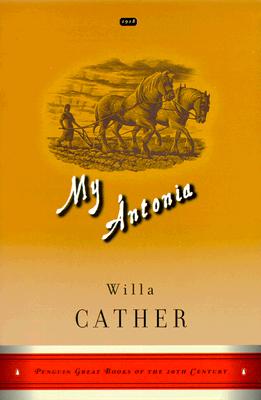
I first asked what we thought of the title, which led to a discussion on our confusion of the pronunciation.  Carolyn said she had listened to it and the narrator said Antoni'a.  Peggy recalled in the book the pronunciation was likened to Anthony, hence An'tonia.  I notice on this book cover, it demonstrates the latter, which we never could get our eye teeth around.  Kathy said we'd just call her Tony.  Then they decided that it was the right title, even though she only appeared in three of the books five sections.  That's what she was called by those near to her. 

I was aware that Cather was considered to be a lesbian and felt that the character of Lena was a little autobiographical.  We talked about how Cather's lifestyle might have influenced the females.  The strongest male characters were in the first half of the book and largely absent in the second half.  Even Jim Burden was undeveloped, though his connection to Tony we felt was likely to resume, perhaps in the form of an uncle. We felt the strongest male character was Mr. Shimerda, though not strong enough to not marry the "hired woman" he impregnated and not strong enough to stand up to her demands they move to American for a better life for Ambrosch. 

We were all confused by Jim and Tony's relationship, wondering if it would become romantic, but as Carolyn pointed out, her being four years old was a big thing in the 19th century when people didn't live all that long.  Kareen noted that the class difference was a huge barrier and her her pregnancy ended any possibility of a romantic connection.  Joanne felt their friendship was sealed on the train and further when Jim taught her to read English.  I was very confused by his declaration "I'd have liked to have you for a sweetheart, or a wife, or my mother or my sister - anything that a woman can be to a man." 

We likened the conclusion of the book to that of So Big.  The protagonist stays in her circumstances but rises above them.  We felt that there would have been no more suitable and happy life for Tony than the one she had with Cuzak.  We all were surprised that she would return to the daily use of Bohemian., and that led to a conversation about the Midwest and the communities who still identify themselves with their nationalities.  I told of the TV show that Ian and I used to watch on RFDTV called the Polka Joe Show.  It was broadcast from various Midwest locations where Polka is still huge and where songs are still sung in their own language.  Jenny said they were visiting Hibbing, Minnesota where a huge polka festival was in full swing.  She said she was astonished that people would travel that far to play poker.  You have to realize that Jenny is a Brit and doesn't pronounce the 'er in poker.  When she says poker it sounds like polka.  That's the laughter that got our door closed.

We were of mixed opinions, but while many found the book a bit of a slog, I think we agreed that for a book published in 1918, it went against the conventional grain.  Cather wrote strong women who were clear in their intentions and some chose to remain unmarried and pursue careers.  A career then was for a woman to be a school teacher.  Carolyn said when a woman married, she was no longer allowed to teach.   We talked about possibly reading another one of Cather's books, but in the future.  We've just read three prairie books in one list:  So Big, Half Broke Horses and now My Antonia.  We seem to cluster our books by accident so Kathy offered to help me with our list next year with little descriptive paragraphs.  We were are talking about 2014 when we haven't started on 2013!

As always, this discussion is limited to my memory and we certainly covered a lot more ground than this.  We're fixing to get ready for our Christmas meeting and potluck.  The general consensus on our December book, The Prime of Miss Jean Brodie, is to watch the movie and appreciate Maggie Smith's Academy Award winning role as Best Actress.  And a good time was had by all.

Tuesday, October 9, 2012

The Paris Wife

I thought today's discussion of The Paris Wife was especially unique in that the book was closely biographical, only not quite.  Maureen noted that we had a similar book with Half Broke Horses, only the author took the liberty to write in the first person and we were critical of that decision.

We have all reading Hemmingway somewhere along our academic paths so I think our discussion today is the only time when we mixed equally what we know about the subject of the fiction along with the narrative of the author.  The book was written in Hadley's voice and yet we talked more about Hem than Hadley. 

Many questions cropped up.  How much did their age disparity matter?  How much authority did Hadley's thoughts carry in the literary debate?  How did the fact that they both had domineering mothers matter - and later fathers who dispatched themselves?  Was Hem ever happy?  And Joann's question - when was convinced of his genius?  How does an brilliant artist know they are brilliant?  Carolyn and I both thought of Picasso. We were flummoxed.

Maureen found an old copy of a book called Hemingway with pictures of all the star players which we passed around - truly beautiful people.  I think we only uncovered the ongoing fascination with the Left Bank artists and an epic writer known affectionately as Papa.  It's clear to me how a semester could be devoted to his life and work.  He was a difficult man but we did agree that he was brilliant.

And then we broke to vote on our reading selection for next year which I've updated in the left column of this blog.  Another wonderful year of reading awaits us.

Tuesday, September 11, 2012

Half Broke Horses

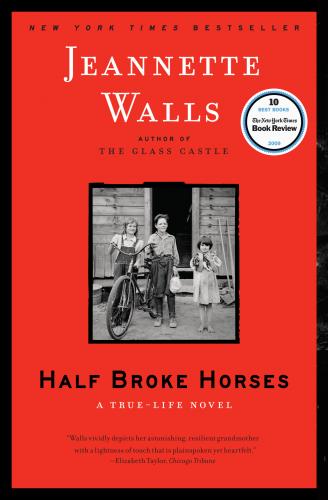
I read this book last Friday in an afternoon and found it very easy to breeze through but wondered what there was to discuss. And today I learned that apparently there wasn't much to talk about.

Those of us who had read Glass Castle found this to be a prequel of sorts and we wandered in to discussions of that book, and for those of you who haven't read it, I hope you will.

None of us liked Lily very much and as Carolyn said, the older she got, the less likeable she because. We enjoyed her father's pithy quotes like "Most important thing in life is learning how to fall." And the places she took us were certainly interesting.

We did feel that the book would have been strengthened if Walls had used the third person for the narrator instead of the first. At time Lily's voice was inauthentic, especially when she was trying to sound tough. Her mothering and nurturing skills were lacking but we commented on how odd the women in her family were in the first place. She didn't have the best teacher in her own mother.

Mary said that her favorite character was Big Jim. We also liked Rooster, the deputy. Diana was fond of Lily's pony, Patches. We talked about the Mormon school where Lily was dismissed and then the discussion migrated away from the book entirely.

We decided we didn't have much left to say about the book, though we liked it and would recommend it. From there we went to the list of suggested titles for 2013 and spent more time on it than on the book.

Tuesday, August 14, 2012

So Big

I had a little trouble with his book as the copy I had ordered from Amazon didn't have the final pages and some of the pages appeared to have been photocopied with sticky notes attached. Ian said he wondered if this edition was one of those print on demand books. Anyway, the last page on my copy concluded "No," Roelf replied, abruptly. "The mouth is smaller than the......" I knew there was more, but I didn't realize that only the final double-sided page was missing and that the Ferber's end was no more conclusive than the end of my copy.

Nevertheless, I loved this book, thought the writing and character development were fantastic and was gratified to hear the rest of the group agree. When we were selecting books last year, I spent all my extra pennies on this and was so happy that it was worth every bit my six cents.

When it was so clearly Selina's story, I asked what the group thought of the title. We were inconclusive and Maureen said she had read that Ferber wanted to change the title, but the publisher was committed to this one. We batted around alternative titles and I liked Cabbages is Beautiful, but Diana said it wouldn't sell copies. Probably not. Kareen wondered if the title referred to Dirk's size which Ferber referred to on a number of occasions.

When we talked about Selina and the coincidences in her life, Connie asked if maybe the title referred to her, to how she traveled the world through the books she read and the people she met. So big. There were a number of coincidences that changed her life; the passing of her husband whom she loved but with whom her farm would never have thrived; that of meeting Julia when she was trying to sell her produce in the male-dominated marketplace; the support and financial help of August Hempel. We decided that they weren't just a construct of fiction. Life is like that.

We also wondered how Selina had failed to foster in Dirk all things that she sacrificed for. We noted that her gambling father had educated her by including her in everything, whereas Dirk was encouraged to not be a farmer, not participate in her life, but to study to become a better person. Mary said that she and her siblings learned that they could escape chores by reading. We all said we had experienced moments of Selina's style of parenting.

Someone thought Dirk's downfall was Paula's manipulative engineering, because while he despised her avowal to only marry for money, he became the same sort of person. He was completely seduced by wealth and the lifestyle that came with it. Who was successful? Selina or Dirk? Remember, this won the Pulitzer.

The ending was certainly curious. Kareen kept saying that just two more paragraphs would have been all we needed. We agreed that Dirk had experienced an eye opening through the visit with the artists on Selina's farm. Mary read from the portion where he went home to his correct console with a correct pile of letters and his correct evening cloths laid correctly on his bed. She was optinistic that he got it. Inside him something said, 'You're nothing but a rubber stamp." I'm with Kareen - just two more paragraphs.

We concluded with the knowledge that everyone was clueless of what was to come in the next five years. Dirk's bond sales would be worth no more than the paper they were printed on. Mary left shaking the book in her hand; top ten she said. This goes in my top ten.