Before we began talking about this book, I passed around a couple copies of Twenty Acres from a Match, which Library Administration would like us to read in January as part of their Nevada Reads program. After browsing through, we agreed that we would make that our January book so now we only need eleven more titles to make up next years list.
Almost everyone of us has read The Glass Castle, Walls' first book and autobiography and thought this was Glass Castle light, a sanitized version of her own tortured youth. Kathy said that she thinks sometimes publishers and agents nudge writers in their stable to write something if they haven't published in a while. She wondered if that had happened with this book.
Mary liked that and said she thought it explained what happened to Pat Conroy when he wrote South of Broad which she felt was below par for him. Joanne responded that while she couldn't remember the characters clearly, she fell in love the Charleston because of the book and took a life-changing trip there with a friend of hers. A lively discussion ensued with Mary rescinding her sharp criticism of the book, saying that she has always felt that any book that changed lives is a valuable book.
Patricia thought Silver Star was a nice three-hour book and I called it a beach read. Mary however thought it read like a young adult novel, and we all tended to agree with her. Aside from Bean, the characters were a little thin, and Joanne said she thought Liz was inconsistent from the beginning through the progression of the book. Claudia reminded us that the girls had no money. When an opportunity to earn comes along, it can cloud ones judgement and in this case, it set the girls up for what came next. I reread the blog post for last months book, and thought Mary's comment would serve well here: "Mary said she was taken by how a single lie (Jim's) could disrupt so many lives for so many years." Keeping their employment secret from Uncle Tinsley was a lie and they did it because they knew he would protest and they wanted the money. If they had told him the truth this would have been a different story.
We thought Charlotte was mentally ill and wondered if signs of it were also showing in Liz. And speaking of mental illness, Angela said that Jerry Maddox was clearly a sociopath and because he had the power to hire and fire, had honed his bully skills. Did everyone believe Clarence thought he shot a bear? We decided they were so glad to be done with him that were willing to buy the story. When they went out the backdoor with Dog and the shotgun however, several of us assumed that Dog was a goner. After all, Maddox had made Clarence give Joe a whipping. So Maddox is gone, and even though it's a questionable ending, you have to be glad that for once the bad guy gets it.. Maureen said that if this is a young adult novel, it would be a good one for adolescent girls to read to know why they should never do what Liz did.
The time of 1970 and the small town setting were critical for the story to work. We batted that around for a while and thought today forensics would shoot holes in the bear story and the girls would probably fall into the foster system. We all enjoyed the book but agreed with the Publishers Weekly reviewer who wrote, "Readers of Walls's bestselling memoir, The Glass Castle, my find this new novel too familiar to be entirely satisfying."
I found the Kelly Corrigan quote which was in the March post. The term is Reader Response: "I remember a lecture from one of my lit classes about a theory called “Reader Response,” which basically says: More often than not, it’s the readers—not the writers—who determine what a book means. The idea is that readers don’t come blank to books. Consciously and not, we bring all the biases that come with our nationality, gender, race, class, age. Then you layer onto that the status of our health, employment, relationships, not to mention our particular relationship to each book—who gave it to us, were we read it, what books we’ve already read—and, as my professor put it, “That massive array of spices has as much to do with the flavor of the soup as whatever the cook intended.”
Tuesday, August 12, 2014
Wednesday, July 9, 2014
The Burgess Boys
We were not united in our feelings about this book which always makes for an interesting discussion. Kathy didn't care for any of the siblings and was especially disgusted by Jim, who always called the twins mean names and acted like he was a demigod. She said she would have preferred that Strout have been selective in what she included in the book; she seemed to have tossed in issues that were on her mind.
Mary said she was taken by how a single lie (Jim's) could disrupt so many lives for so many years. Peggy said she wasn't sure what we knew who was responsible for the accident. Susan always thought it had been her since their mother had been so mean to her.
No one liked Helen or had much sympathy for her. As despicable as Jim was, we liked his wife even less. And in the final discussion, wondering if she would allow him back into her life, we were less interested in that than we were wondering how suicidal he was.
We loved Bob. Who didn't love Bob! It was nice to see Bob love Bob too, and when he started to love himself, he left the "graduate dorm" for a upscale apartment where he found himself picking up his own socks, the thing that so annoyed his wife Pam. Ah Pam, we were so glad to see him stop being available to her needy moments and kindly step away. The end of the book doesn't make Bob's future clear, but on the second page of the prologue Strout had written, "Bob's second wife, and we hoped his last, was a Unitarian minister." It was only though that slip that we realized he married Margaret - after the book concluded. It kind of makes you want a sequel.
Maureen read that Strout based this book on a true story, but in reality the young man had committed suicide. Zach was such a lonely and haunted boy, deeply dependent on his mom and without friends. We were all on pins and needles, thinking that was the end that Zach was headed for. Kareen questioned how he was able to spontaneously make Visa and international flight arrangements.
Susan's recognition that she had become her mother and turned her children and husband Steve into herself seemed like a miracle of self awareness, not something many adults are capable of. Mary reminded us of the agonizing hours that Susan spent alone, terrified that Zach was dead. She had plenty of time for introspection.
Kareen thought Strout tied up things a little too quickly in the conclusion, Zachary was home looking good and talkative. Thanks to Jim's revelation, Bob was no longer his old doormat self, his "Bobness" and Susan was talking opening to Mrs Drinkwater and blossoming. Which left the question - who were the mother and daughter from the prologue? Was it one of Mrs Drinkwater's daughters who wrote it?
Mary said she was taken by how a single lie (Jim's) could disrupt so many lives for so many years. Peggy said she wasn't sure what we knew who was responsible for the accident. Susan always thought it had been her since their mother had been so mean to her.
No one liked Helen or had much sympathy for her. As despicable as Jim was, we liked his wife even less. And in the final discussion, wondering if she would allow him back into her life, we were less interested in that than we were wondering how suicidal he was.
We loved Bob. Who didn't love Bob! It was nice to see Bob love Bob too, and when he started to love himself, he left the "graduate dorm" for a upscale apartment where he found himself picking up his own socks, the thing that so annoyed his wife Pam. Ah Pam, we were so glad to see him stop being available to her needy moments and kindly step away. The end of the book doesn't make Bob's future clear, but on the second page of the prologue Strout had written, "Bob's second wife, and we hoped his last, was a Unitarian minister." It was only though that slip that we realized he married Margaret - after the book concluded. It kind of makes you want a sequel.
Maureen read that Strout based this book on a true story, but in reality the young man had committed suicide. Zach was such a lonely and haunted boy, deeply dependent on his mom and without friends. We were all on pins and needles, thinking that was the end that Zach was headed for. Kareen questioned how he was able to spontaneously make Visa and international flight arrangements.
Susan's recognition that she had become her mother and turned her children and husband Steve into herself seemed like a miracle of self awareness, not something many adults are capable of. Mary reminded us of the agonizing hours that Susan spent alone, terrified that Zach was dead. She had plenty of time for introspection.
Kareen thought Strout tied up things a little too quickly in the conclusion, Zachary was home looking good and talkative. Thanks to Jim's revelation, Bob was no longer his old doormat self, his "Bobness" and Susan was talking opening to Mrs Drinkwater and blossoming. Which left the question - who were the mother and daughter from the prologue? Was it one of Mrs Drinkwater's daughters who wrote it?
Friday, June 20, 2014
The Sister
In the absence of our leader, Sharon, Maureen is
attempting to write a synopsis of our discussion. I won't try to attribute comments to a
particular person but will try to summarize the group as a whole. We used many of the questions in the Reader's
guide to stimulate discussion.
Everyone seemed to like the book, which we commented was
unusual. And as the discussion
progressed it was evident that the author did a good job of making this a
mystery. No one seemed to know who the
killer was until the end, guessing instead Emilio's wife, Dr. Nichols and
Professor Rosen. We also thought that
Mr. Wright was real and were a little disappointed that he was not. We thought that the structure of the book, an
interview with Mr. Wright and a letter to the sister, Tess, was an effective
although unusual way of telling the story and we compared it to the Guernsey
and Bernadette books that we read this year, with letters and emails as
conveyances. We were not all sure that Bea was rescued at the end but thought
that Kasia would have been Bea's only hope.
Some of us wanted a sequel.
We thought that the sisters' relationship and that of
their mother were deeply affected by the death of their brother and the absence
of their father. We thought the mother
seemed to soften at the end after also losing Tess. Some of us thought that the sisters seemed to
be more mature than their ages of 21 and 26 indicated, one an artist and the
other in an established career in New York.
We were confused as to how Tess had time to do several
violent paintings in the week between the death of her baby and her own
death. And we pieced together that
William was giving her drugs which created hallucinations. We figured out that the babies of Tess and
Kasia did not have cystic fibrosis but were given the other gene therapy which
caused breathing problems. We think that
Bea will help Kasia's baby in the sequel.
All in all we had fun being detectives with this book.
Tuesday, May 13, 2014
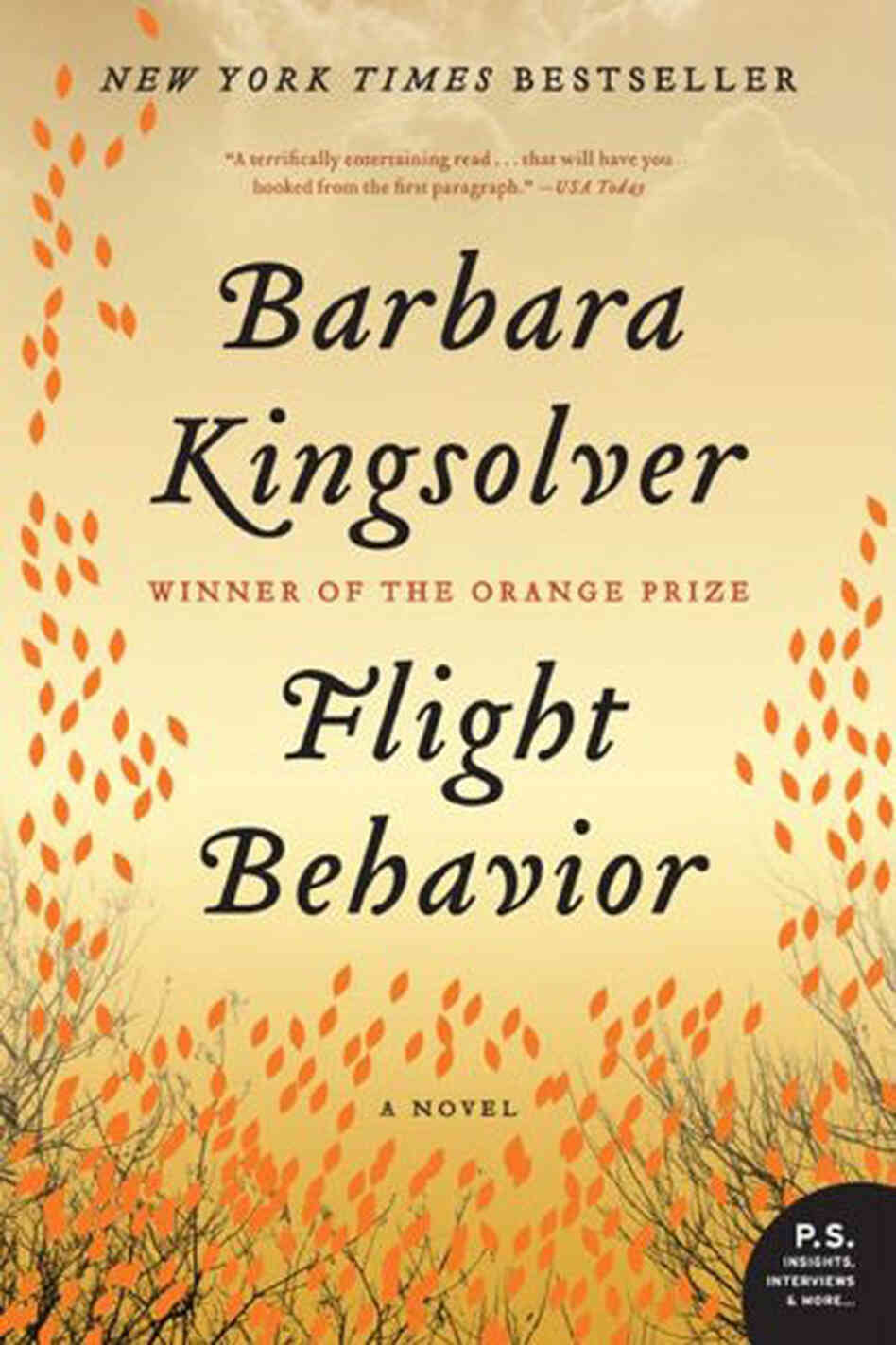
Flight Behavior
Book club today was a treat on many levels. Carolyn had flown in to visit her sister Connie and to celebrate, Peggy brought carrot cake cupcakes. She said if we didn't get to have a going away party, at least we could celebrate with a coming back party. And after reading this book, she brought silverware forks to be washed later.
The book had a lot of issues and it was long so not everyone was able to finish in time, but in the context, it didn't seem to matter. We never got to the publishers questions and the discussion never flagged. We pretty much agreed that the first couple of chapters were hard to get into and perhaps it's because we trusted the author, we continued. Peggy said she didn't really start to enjoy it until half way.
She had taught school in a poor Appalachian town for three years and told us that it's pronounced, Apaha-lach-ee. Her principal had corrected her and when she said, I was always taught to say, Apah-lay-chee, he said - yeah, we get stuff wrong down here. She said it let her know where she stood.
Several of the ladies had lived in poor communities in the south and we spent some time talking about the grinding hopelessness of their lives. Kingsolver wrote a dialogue between Ovid and Dellarobia, talking about her abysmal science and math scores on the college entrance test. She explained that it was because the teachers didn't like those subjects and substituted PE instead. Peggy said that the weakest teachers she had taught with were at that school.
We also talked about the role of the church in a community. They all said that it was huge, about as huge as football. Hester's was heavily involved in their church. I thought it was because it gave her legitimate contact with Bobby, but they said no - a church is core to a community. I thought when Bear said that weather was the Lord's business, he was using that as an excuse. The ladies said no - remember that he was willing to turn to their pastor for advice and mediation. Did Bear know that Bobby was his own son? I didn't think to wonder until I was driving home.
We talked about Dellarobia and Hester's parallel stories and how circumstances provided different outcomes. Hester always felt that Dellarobia would leave one day. Maureen reminded us that is why she remained distant to her grandchildren, knowing she would lose them. Dellarobia's flight fantasies were always with other men, until she began to awaken to her own potential. We all said that we had hoped that she and Cub would make things work, but what Hester had anticipated was right. We liked Cub and after batting it around, agreed that he would be happier not feeling like he had to apologize and maybe get some praise.
Mary asked what we thought about the ending. I was struck by the house with all their living and all their experiences just lifted up and floated away, like it erased their marriage. Everyone was taken by Dellarobia's bold step, a result of a slow blooming over the course of tracking the butterflies and what a change this also meant for her children. It was hard to end a book with the end of a marriage as a means to a future - we had hope for some kind of bridge between their two world. At that point there was no going back, and as Maureen said, she had no choice. We had a couple of flights - the Monarchs and Dellarobia. She wasn't the same woman anymore. Brilliant book! This is on college reading lists and I think we did a good job parsing out points in our limited time.
The book had a lot of issues and it was long so not everyone was able to finish in time, but in the context, it didn't seem to matter. We never got to the publishers questions and the discussion never flagged. We pretty much agreed that the first couple of chapters were hard to get into and perhaps it's because we trusted the author, we continued. Peggy said she didn't really start to enjoy it until half way.
She had taught school in a poor Appalachian town for three years and told us that it's pronounced, Apaha-lach-ee. Her principal had corrected her and when she said, I was always taught to say, Apah-lay-chee, he said - yeah, we get stuff wrong down here. She said it let her know where she stood.
Several of the ladies had lived in poor communities in the south and we spent some time talking about the grinding hopelessness of their lives. Kingsolver wrote a dialogue between Ovid and Dellarobia, talking about her abysmal science and math scores on the college entrance test. She explained that it was because the teachers didn't like those subjects and substituted PE instead. Peggy said that the weakest teachers she had taught with were at that school.
We also talked about the role of the church in a community. They all said that it was huge, about as huge as football. Hester's was heavily involved in their church. I thought it was because it gave her legitimate contact with Bobby, but they said no - a church is core to a community. I thought when Bear said that weather was the Lord's business, he was using that as an excuse. The ladies said no - remember that he was willing to turn to their pastor for advice and mediation. Did Bear know that Bobby was his own son? I didn't think to wonder until I was driving home.
We talked about Dellarobia and Hester's parallel stories and how circumstances provided different outcomes. Hester always felt that Dellarobia would leave one day. Maureen reminded us that is why she remained distant to her grandchildren, knowing she would lose them. Dellarobia's flight fantasies were always with other men, until she began to awaken to her own potential. We all said that we had hoped that she and Cub would make things work, but what Hester had anticipated was right. We liked Cub and after batting it around, agreed that he would be happier not feeling like he had to apologize and maybe get some praise.
Mary asked what we thought about the ending. I was struck by the house with all their living and all their experiences just lifted up and floated away, like it erased their marriage. Everyone was taken by Dellarobia's bold step, a result of a slow blooming over the course of tracking the butterflies and what a change this also meant for her children. It was hard to end a book with the end of a marriage as a means to a future - we had hope for some kind of bridge between their two world. At that point there was no going back, and as Maureen said, she had no choice. We had a couple of flights - the Monarchs and Dellarobia. She wasn't the same woman anymore. Brilliant book! This is on college reading lists and I think we did a good job parsing out points in our limited time.
Tuesday, April 8, 2014
Americanah
This book was my recommendation and if you didn't care for it, I apologize. I knew nothing about the book, only that it was on just about every list. The book title refers to someone who has lived in America and returned to Nigeria. I had read her first book and liked her writing. If your eyes glazed over at 400 pages (or less), I'm sorry but - I really loved it. There I said it.
I think we had an outstanding discussion on a book that will most likely show up college recommended reading lists for years to come, and those classes will give the book more then 90 minutes of their time.
The book at its basest level was about racism. We felt that Adiche clearly had race in her mind when she started to write. The characters, and there were many - almost too many - brought faces and feelings to the experience. She wrote that race is not about biology, it's about sociology. We saw racial prejudice in Nigeria, the UK and the US and we grew to care about the characters. Maureen said that she recently read a piece saying that fiction is what you read to feel the experience. Snobbish readers who say they only read nonfiction miss out.
We liked Obinze and felt he was a kind man. None of us understood why Ifem (saving vowels and misspellings) broke all ties with him over the event with the tennis coach. Someone said that she was self-sabotaging. Mary reminded us that she was depressed, whether she wanted to call it that or not. She had run out of money and simply could not get a job. It's easy to be critical but her circumstances were extraordinary. I had a hard time liking her after she broke up with both Blaine and Curt, but then later wanted to keep them on the string. Angela said she felt the same.
We were fortunate that both Peggy and Mary have experiences in Africa and helped us see the circumstances more clearly. Mary talked about how important education was and how families would invest everything to make sure their children had good schooling. Peggy said it's caste system, much like India. The landlord didn't want to rent to Ifem because she was Igbo and her hair wrapper's boyfriend wouldn't marry her because she was Igbo. Adiche wrote that lighter skinned Nigerians had better opportunities.
Angela both said they learned a lot from the book. She admitted that she hadn't necessarily liked it but was glad she had read it, though she found Ifem spoiled. Kareen said she hadn't finished it - wasn't sure she would. Joanne appreciated seeing a different side of Nigerian culture other than the home of the "scam." Peggy said that she felt that the tone was one of loneliness and discontent.
We talked a lot about Ifem's blog. Mary said that if you flipped through it you'd get a nice synthesis of the book and it's intended message, that of a non-American Black on race. It's impossible to cover all the points of this nearly 600-page book here, but Adiche touched on many: the self-satisfied smug rich white Americans and their favorite African charities, what it's like to have a President who looks like you, the issues Black women have with hair styles, Whites who pretend to not notice skin color, the difficultly of a minority teen to fit in, and well - you know.
The conclusion was wide open. Diana said - you just don't know. And we don't. Will Ifem sabotage the relationship like others in her past, destroying a family in the process, or is this the thing that she's been missing and trying to get back all along? We'll never know.
Our March meeting was the last before Carolyn moved away so I took pictures. I'd like to periodically do this so can have a record of our group. We've been together for a long time.
I think we had an outstanding discussion on a book that will most likely show up college recommended reading lists for years to come, and those classes will give the book more then 90 minutes of their time.
The book at its basest level was about racism. We felt that Adiche clearly had race in her mind when she started to write. The characters, and there were many - almost too many - brought faces and feelings to the experience. She wrote that race is not about biology, it's about sociology. We saw racial prejudice in Nigeria, the UK and the US and we grew to care about the characters. Maureen said that she recently read a piece saying that fiction is what you read to feel the experience. Snobbish readers who say they only read nonfiction miss out.
We liked Obinze and felt he was a kind man. None of us understood why Ifem (saving vowels and misspellings) broke all ties with him over the event with the tennis coach. Someone said that she was self-sabotaging. Mary reminded us that she was depressed, whether she wanted to call it that or not. She had run out of money and simply could not get a job. It's easy to be critical but her circumstances were extraordinary. I had a hard time liking her after she broke up with both Blaine and Curt, but then later wanted to keep them on the string. Angela said she felt the same.
We were fortunate that both Peggy and Mary have experiences in Africa and helped us see the circumstances more clearly. Mary talked about how important education was and how families would invest everything to make sure their children had good schooling. Peggy said it's caste system, much like India. The landlord didn't want to rent to Ifem because she was Igbo and her hair wrapper's boyfriend wouldn't marry her because she was Igbo. Adiche wrote that lighter skinned Nigerians had better opportunities.
Angela both said they learned a lot from the book. She admitted that she hadn't necessarily liked it but was glad she had read it, though she found Ifem spoiled. Kareen said she hadn't finished it - wasn't sure she would. Joanne appreciated seeing a different side of Nigerian culture other than the home of the "scam." Peggy said that she felt that the tone was one of loneliness and discontent.
We talked a lot about Ifem's blog. Mary said that if you flipped through it you'd get a nice synthesis of the book and it's intended message, that of a non-American Black on race. It's impossible to cover all the points of this nearly 600-page book here, but Adiche touched on many: the self-satisfied smug rich white Americans and their favorite African charities, what it's like to have a President who looks like you, the issues Black women have with hair styles, Whites who pretend to not notice skin color, the difficultly of a minority teen to fit in, and well - you know.
The conclusion was wide open. Diana said - you just don't know. And we don't. Will Ifem sabotage the relationship like others in her past, destroying a family in the process, or is this the thing that she's been missing and trying to get back all along? We'll never know.
Our March meeting was the last before Carolyn moved away so I took pictures. I'd like to periodically do this so can have a record of our group. We've been together for a long time.
Tuesday, March 11, 2014
How to Get Filthy Rich in Rising Asia
It's been quite a while since we've been so divided on a book. It was about two to one, dislikes to likes. Mary really helped us all think again about what the book was and what the author wanted to say. I appreciated seeing it through her eyes.
I emailed a quote from Kelly Corrigan in my meeting reminder and we talked about it again today. For posterity:
I remember a lecture from one of my lit classes about a theory called “Reader Response,” which basically says: More often than not, it’s the readers—not the writers—who determine what a book means. The idea is that readers don’t come blank to books. Consciously and not, we bring all the biases that come with our nationality, gender, race, class, age. Then you layer onto that the status of our health, employment, relationships, not to mention our particular relationship to each book—who gave it to us, were we read it, what books we’ve already read—and, as my professor put it, “That massive array of spices has as much to do with the flavor of the soup as whatever the cook intended.”
Hamid's narrator added to this: "It's in being read that a book becomes a book, and in each of a million different readings a book becomes one of a million different books, just as an egg becomes one of potentially a million different people when it's approached by a hard-swimming and frisky school of sperm."
Kathy felt this book demonstrated the Reader Response perfectly. We all interpreted the nameless country as different geographic locations and had equally different responses to the events in the book. We did agree that the format, in the second person, without names or place, allowed the telling of a universal story, which laid bare a broken and corrupt society somewhere in Asia. Throughout this, he (the nameless you) maintained a certain level of morality, refusing to lower his standards to provide safe water or to provide a comfortable life for his wife and son.
The narrator provided a note of humor periodically as in the above quote on books. Carolyn laughed at his advice to be the third child, which gives one a much better economic advantage. He could also be pithy re/his son: "You feel a love you know you will never be able to adequately explain or express to him, a love that flows one way, down the generations, not in reverse, and is understood and reciprocated only when time has made of a younger generation an older one."
Mary liked the spoof of it being a self-help book and thought it playful. She especially liked how he had come from nothing and become rich, lost most of his money, but died having loved and been loved. We thought that he was content with the last days of his life with the Pretty Woman, playing cards and enjoying the camaraderie. We agreed that the only successful relationship they could have had was the one they did have.
The discussion was brief. I mentioned that this book was short-listed for the Man Booker which made Joanne laugh and say to Kathy - we seem to have problems with Bookers, don't we? I know that's true, but we did love the long-listed Unlikely Pilgrimage of Harold Fry. At least more people liked this than Midnight's Children. So many books, so little time.
I emailed a quote from Kelly Corrigan in my meeting reminder and we talked about it again today. For posterity:
I remember a lecture from one of my lit classes about a theory called “Reader Response,” which basically says: More often than not, it’s the readers—not the writers—who determine what a book means. The idea is that readers don’t come blank to books. Consciously and not, we bring all the biases that come with our nationality, gender, race, class, age. Then you layer onto that the status of our health, employment, relationships, not to mention our particular relationship to each book—who gave it to us, were we read it, what books we’ve already read—and, as my professor put it, “That massive array of spices has as much to do with the flavor of the soup as whatever the cook intended.”
Hamid's narrator added to this: "It's in being read that a book becomes a book, and in each of a million different readings a book becomes one of a million different books, just as an egg becomes one of potentially a million different people when it's approached by a hard-swimming and frisky school of sperm."
Kathy felt this book demonstrated the Reader Response perfectly. We all interpreted the nameless country as different geographic locations and had equally different responses to the events in the book. We did agree that the format, in the second person, without names or place, allowed the telling of a universal story, which laid bare a broken and corrupt society somewhere in Asia. Throughout this, he (the nameless you) maintained a certain level of morality, refusing to lower his standards to provide safe water or to provide a comfortable life for his wife and son.
The narrator provided a note of humor periodically as in the above quote on books. Carolyn laughed at his advice to be the third child, which gives one a much better economic advantage. He could also be pithy re/his son: "You feel a love you know you will never be able to adequately explain or express to him, a love that flows one way, down the generations, not in reverse, and is understood and reciprocated only when time has made of a younger generation an older one."
Mary liked the spoof of it being a self-help book and thought it playful. She especially liked how he had come from nothing and become rich, lost most of his money, but died having loved and been loved. We thought that he was content with the last days of his life with the Pretty Woman, playing cards and enjoying the camaraderie. We agreed that the only successful relationship they could have had was the one they did have.
The discussion was brief. I mentioned that this book was short-listed for the Man Booker which made Joanne laugh and say to Kathy - we seem to have problems with Bookers, don't we? I know that's true, but we did love the long-listed Unlikely Pilgrimage of Harold Fry. At least more people liked this than Midnight's Children. So many books, so little time.
Tuesday, February 11, 2014
And the Mountains Echoed
Our session today was well attended and also one of the shortest book discussions we've ever had. We all liked the book, but the two who enjoyed it the most are Mary and Carolyn who had read it last year, then reread it for today. The rest of us were floundering a bit with all the side stories.
I started the comments by reading those that Kareen emailed me:
I was disappointed in that he didn't develop more of his characters and some he didn't even need to include (Idris & Timur, perhaps Marcos and Thalia and others in that chapter). The latter two could have a book of their own. The book was really about Pari (the sister) more than anyone else it seems. She actually ended up better off for leaving her old village even though it broke Saboor and left Abdullah missing his best friend (only to forget her in the end because of Alzeimer's). Saboor had to support the family he had left, to prevent other children from dying in the winter, the stove for him was a necessary evil. The apple tree was cut down to supply the town with heating wood but also to signify the end of a family as he had known it...to destroy all those memories, both good and bad (depending on whose memory was part of the tree). Oh, then we have the tale of Parwana and Massoma....just a lot of hit and miss all over. It seems like there needed to be more focus for a story. The book just went all over the place just like my comments seem to be doing.
I said that it seemed like Hosseini almost wanted to write a short story collection but didn't follow through. Maureen said she found some comments online, one saying that it indeed was a collection with nine separate stories.
We thought this was the most autobiographical of Hosseini's three books, for example: a physician figured prominently, the locale shifted several times to include places he had lived, and his father had worked hard to get his family off welfare after settling in California, as had Abdullah.
Because there were so many threads, a couple of us missed cues here and there. I for one didn't realize that Parwana had pushed Masooma from the tree. We wondered why Hosseini had weighted some stories, like Pari's marriage and children, and slighted others like Iqbal and Gholam's return from Pakistan. Claudia was surprised that they could come back and expect to find their property waiting for them, like maybe there would be a statue of limitations, but Jenny said there's no such thing. Look at the Jews trying to recover items stolen during WWII.
Diana read the passage from some comments she found online -"A story is like a moving train: no matter where you hop onboard, you are bound to reach your destination sooner or later." And truly this story was just that, with lots of storylines in between getting on and getting to the end. And speaking of end, we were all disappointed by the facile wrap-up, just a little too convenient and quick to be consistent with the earlier tone of the book.
We talked about the role of warlords in contemporary Afghanistan and Carolyn said that's why the government is having such a hard time getting power and respect. They can't provide for the people like the warlords do, which she called the price of submission. Maureen said she didn't get the sense of place being specifically Afghanistan, and Barbara said she could see it being India or Iran.
The meeting concluded abruptly when someone mentioned the X-Ray feature in Kindle. We spontaneously broke into small groups and explored it's function on our different devices.
I started the comments by reading those that Kareen emailed me:
I was disappointed in that he didn't develop more of his characters and some he didn't even need to include (Idris & Timur, perhaps Marcos and Thalia and others in that chapter). The latter two could have a book of their own. The book was really about Pari (the sister) more than anyone else it seems. She actually ended up better off for leaving her old village even though it broke Saboor and left Abdullah missing his best friend (only to forget her in the end because of Alzeimer's). Saboor had to support the family he had left, to prevent other children from dying in the winter, the stove for him was a necessary evil. The apple tree was cut down to supply the town with heating wood but also to signify the end of a family as he had known it...to destroy all those memories, both good and bad (depending on whose memory was part of the tree). Oh, then we have the tale of Parwana and Massoma....just a lot of hit and miss all over. It seems like there needed to be more focus for a story. The book just went all over the place just like my comments seem to be doing.
I said that it seemed like Hosseini almost wanted to write a short story collection but didn't follow through. Maureen said she found some comments online, one saying that it indeed was a collection with nine separate stories.
We thought this was the most autobiographical of Hosseini's three books, for example: a physician figured prominently, the locale shifted several times to include places he had lived, and his father had worked hard to get his family off welfare after settling in California, as had Abdullah.
Because there were so many threads, a couple of us missed cues here and there. I for one didn't realize that Parwana had pushed Masooma from the tree. We wondered why Hosseini had weighted some stories, like Pari's marriage and children, and slighted others like Iqbal and Gholam's return from Pakistan. Claudia was surprised that they could come back and expect to find their property waiting for them, like maybe there would be a statue of limitations, but Jenny said there's no such thing. Look at the Jews trying to recover items stolen during WWII.
Diana read the passage from some comments she found online -"A story is like a moving train: no matter where you hop onboard, you are bound to reach your destination sooner or later." And truly this story was just that, with lots of storylines in between getting on and getting to the end. And speaking of end, we were all disappointed by the facile wrap-up, just a little too convenient and quick to be consistent with the earlier tone of the book.
We talked about the role of warlords in contemporary Afghanistan and Carolyn said that's why the government is having such a hard time getting power and respect. They can't provide for the people like the warlords do, which she called the price of submission. Maureen said she didn't get the sense of place being specifically Afghanistan, and Barbara said she could see it being India or Iran.
The meeting concluded abruptly when someone mentioned the X-Ray feature in Kindle. We spontaneously broke into small groups and explored it's function on our different devices.
Subscribe to:
Posts (Atom)