Wednesday, February 10, 2010

East of Eden

Yesterday nine intrepid book lovers came together to deliberate the merits of the book John Steinbeck considered his opus, and Kathy was quick to agree with his assessment. Welcome to Jan and Cheryl - thanks for joining us. I find it remarkable that each month we almost always are an assembly of nine, just not the same nine - a supreme court, of sorts I suppose.

We were quick to agree that Sam Hamilton was our favorite character, closely followed by Lee. The serpent was Cathy/Kate with her little mouth, sharp teeth, pointed darting tongue and small, lobeless ears close to her head. Who was Eve? The book is rich with symbolism and we had a lot of fun sharing the things we had already uncovered and discovering things we had missed. We thought that Cain and Abel were both Adam and Charles and Caleb and Aron.

Just what or where was Eden? Kareen and Cheryl talked about the garden that Adam had planned to build but didn't, or was it the Salinas Valley, which would then place the Trask place to the east of it? And who was Eve? We couldn't decide. Was it Lee? We loved Lee's theological discussion with Sam over the Genesis story, and Timshel - thou mayest, and Steinbeck's use of it to close the book.

Abandonment is key to the story - all these people left to figure things out on their own, children without mothers and absent fathership. Cal tortured himself that he was the son of a whore, but didn't get much sympathy from Abra whose father was a thief. Cal said, "but I've got her blood," and Abra said, "I've got his." "They walked along in silence while he tried to rebalance himself." We felt that Cal and Abra would go on to a healthy, and probably the only whole marriage in the cast.

It was painful as I read to realize that for the story to follow the allegory, Cal had to be responsible for Aron's death in some form because I just liked Cal better. Aron was withdrawing from the real world and living in a world of his own making, much like his grandfather, Cyrus. I can't remember who pointed that out. Abra complained that Aron didn't know her, but was making her a virtuous woman, an untruth.

Speaking of truth, Sheriff Quinn said, "Adam could do no dishonesty." We talked about the fact that he rejected Cal's money as ill-gotten gains, yet lived on his father's ill-gotten inheritance. No one liked Adam and we were reminded that before he got his money, he was a hobo. Kathy decided that he was just lazy and without the money, he probably would still be a hobo. We wondered what was going to happen to Kate's ill-gotten money, which she left to Aron. And why only to Aron, not Cal? Several asked, did they have two fathers? Sam pointed out that there were two sacks.

We thought about maybe putting a Steinbeck on next years book list, but Kathy begged us to rethink that. She says she has enough of him for now, having read four in the last couple of months. Kareen suggested she try "Travels with Charlie." We might want to think about that one for next year. We did change the September book from The Rule of Four by Ian Caldwell to The Women by T.C. Boyle and I have changed that in the reading list for this year that I posted in an earlier blog. Please feel free to add your comments.

Wednesday, January 13, 2010

Plainsong

We welcomed two new ladies this month, Cindy and Kareen, and for the first time ever at Jenny's suggestion, started with introductions, something that was long overdue. Ironically, it seems that almost everyone has been a teacher at one point or another. Do all of us own cats too?

We loved this book, loved it from the book title play on words to the open ending, where the characters who have stayed true to their principles face a murky and unclear future. Principled principles?? As Madelon said, the writing was remarkable as much for what wasn't said, as for what was.

Considerable discussion took place around abandonment: Guthrie's preoccupation with his own difficulties, the withdrawal of Ike and Bobby's mother, Victoria's mother locking her out of the house and her life, and the orphaning of the McPheron's at an early age. We questioned if the Beckman's violent home was a form of abandonment of their son.

Linda said when she taught at the juvenile detention center, they often wondered what made some children survivors and others not. Certainly, Victoria was a survivor and wise beyond her years. Why her and not the Beckman boy? And much of the story was determined by the time in which is was placed and the small town locale.

So little is known about the characters outside of this six month period. We don't know what happened between Victoria and her mother earlier. We felt that Tom Guthrie was a good man, even though he had been vague as a father in this pastiche. Maggie was our favorite character, and we can only determine that Tom's daliance with the secretary was because he felt he didn't deserve Maggie, something he told himself in the mirror.

We were thrilled to have a story that flowed through so few characters. It read so easily, it seemed to be a simple book, which it certainly was not. We loved the McPherons and their taciturn manner of speach. I said I could see Robert Duvall playing one of them in a movie, because I had seen him in a similar role. That movie was Tender Mercies and it won the 1983 Oscar and he the Oscar for best actor - little aside there. The parallel lives of the McPherons and Ike and Bobby was deftly woven through the narrative, yet not overworked.

I hadn't checked my phone after I got to the library and had received an email from Leslie, explaining why she wouldn't be able to make it. Below are her notes - I thought you would enjoy hearing from her.

"I enjoyed reading Kent Haruf's Plainsong. I like how it took turns with the characters and then ends with the chapter entitled "Holt," the town, yet that chapter isn't about a small town. A small town is the sum of the people living there and so "Holt" brings all the main characters together and now a family of sorts, yet perhaps the best kind of family in this dysfunctional society.

Many of the scenes are really vivid, slices of life--so realistic we become flies on the wall, watching what's happening to the main characters. And there's some great dialogue, especially from the two McPheron brothers, Raymond and Harold. I love when Harold and Raymond squabble over Harold's comparing Victoria to a heifer and also when the creep in the convenience store gets his pack of gum and tells Victoria to not work too hard after he's scared the heck out of her with his crazy talk about killing himself, the dog, and one of the gals working at the convenience store.

Also, some could argue that everything seemed gift-wrapped and tidy at the end, yet it really isn't. Guthrie may get fired, and he has no idea what he'll do (except not farm); his sons, Bobby and Ike, have experienced a lot of trauma at [e.g., deaths (horse and Mrs. Stearns); the really scary kidnapping; the physical and emotional loss of their mother]; the McPheron brothers still will lose Victoria and her daughter at some point, so Victoria can go to college, although we think, even when that happens, she and the baby will be back to visit if not to stay; and Maggie's father will die. Life will go on in Holt."

What she said~

Wednesday, December 16, 2009

2010 Reading List

January: Plainsong - Kent Haruf
February: East of Eden - John Steinbeck
March: Pillars of the Earth - Ken Follett
April: A prayer for Owen Meaney - John Irving
May: The Chosen - Chaim Potok
June: Fried green tomatoes at the Whistle Stop Cafe - Fannie Flagg
July: A yellow raft in blue water - Michael Dorris
August: A tree grows in Brooklyn - Betty Smith
September: The Women - T.C. Boyle
October: The gathering - Anne Enright
November: The inheritance of loss - Kiran Desai
December: March - Geraldine Brooks

Tortilla Flat

In spite of the last minute rescheduling of yesterdays meeting, we had eight intrepid book lovers. I would characterize the mood as a cross between hilarity and conviviality. Madelon brought a crockpot full to the brim with magnificent soup that was so fragrant we were compelled to eat first, then discuss later, which was almost a mistake. After an hour of food and laughter, it was apparent that this book wasn't fore in anyone's mind. Finally, Madelon sat back, folded her arms and challenged me to bring the group into control. I'm watching, she said. We laughed at that too. We laughed at everything and I can't remember what was so funny - maybe everybody? And who knew Jeanette could sing and used to have a band?!

To everyones credit, we did have a discussion, albeit brief. No one truly enjoyed the book and we wondered how it has maintained its status as a classic. It was one of his earlier works and we felt the transition from chapter to chapter was choppy and stiff, though we agreed that it was a brilliant chronicle of characters he had encountered in Monterrey.

Dolores said that if there was one character she could say she liked, it would be The Pirate because of the care he had for his dogs. We agreed. Leslie said the paisanos reminded her of the Portagees in Mendicino, also a fishing based economy where the red wine flowed. Since it didn't feel like a story with a beginning, middle and end, we talked about the people and their lifestyle.

Dolores felt it was a chronicle of desperate and chronic poverty. No one had clothes decent enough to go to Danny's funeral. I had never understood the Bible story about going to a funeral without appropriate clothes until I as driving home and then it made sense, except in Tortilla Flat, it wasn't a matter of choice but dictated by empovrishment.

Madelon read from the foreword of her copy written by an Arthurian scholar and comparing The Round Table with Danny's paisanos. It's clear from Steinbeck's occasional use of Elizabethan English that he had intended the comparison. Is this the key to this book's continuing classic status and high school required reading?

We finalized the reading list and assigned months which I will put in a separate post so you can find it again in the future. Some book discussions have taken an hour and a half. This one was about a half hour and then we went back to hilarity and convivality. I think the Christmas potluck has to be a tradition.

Tuesday, November 10, 2009

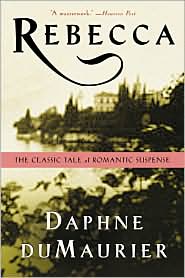
Rebecca

Leslie asked me who picked out this book and I have to confess that it was me. We can’t blame Libby for this one. I bought it at Costco about a year ago. I had read it years ago, remembered it fondly and realized that I really wanted to read it again. I recalled it being a love story with a little suspense. Those of us who had read it before had the same feeling. None of us came to the discussion today feeling that we had just read “a classic tale of romantic suspense,” which is what it was billed as on the cover of my copy.

We realized by Mrs. Danvers revelation in talking to Favell that Rebecca may well have had lesbian relationships, which the author herself was known to have. We weren’t quite clear on the relationship between Mrs. Danvers and Rebecca, but it certainly might have been more intimate than just housekeeper and madam, since Rebecca was carrying on with her own cousin. Madelon pointed out that while Favell was deluded into thinking that Rebecca was going to marry him, she would never have given up her plush life for a bounder.
The narrator is never given a name and the book is named for the deceased wife, two powerful and effective conventions. We questioned whether Maxim ever loved either of his wives or anyone for that matter. We talked a little about the role of the Oedipus/Electra complex and certainly part of the girl’s infatuation was transference for her lost father. Interesting that Max’s proposal was “instead of being companion to Mrs. Van Hopper, you become mine, and your duties will be almost exactly the same.” We agreed that she remained a paid companion, just to another paid companion.

Maureen labeled Maxim was ineffectual and weak, treating the girl with the same affection he showed to Jasper, his dog. We felt that the change came from him being the caretaker/parent shifted when she agreed to be complicit with his crime, and at that point she gained power and became the caregiver/parent. Leslie said that the novel creeped her out, and I’d have to agree with her, although I did read it in two sittings. Wasn't it cool that the whole unfolding played out in a monstrous storm?!

“Last night I dreamed I went Manderley again.” What a powerful opening sentence and what a powerful setting. The estate was another one of the characters. Linda was impressed by the tower of blood red rhododendrons and thought them a good analogy for Rebecca, she who had the West Wing overlooking the sea with its power and sound. The girl’s room was the East Wing, overlooking the garden – a reflection of her timidity? (Note that in her opening line she used the pronoun “I.”)

We felt for the girl whose choices never were very good. Madelon wondered how the girl could ever feel safe, knowing that her husband had already committed a murder. How easily it was rationalized – she made me do it. We all really liked the book, though I have to agree with Sherry that the pace lagged a little near the end with all the discussions in the parlor, ala Agatha Christy. We also talked about how it fits the criteria for gothic novel. Dolores felt that the ghost was the spirit of Rebecca, even if it weren’t a supernatural ghost. Certainly it was her story.

I can’t do our discussion justice in a few short paragraphs when we talked about the book for an hour and a half. We decided that the book wouldn’t transfer to a newer time setting since forensic evidence would convict Maxim. Realize that all of this happened in four months and then they had the rest of their lives to live it out. While Maxim didn’t go to prison, weren’t their ex patriot lives a sort of prison? Linda said she was reminded of the Duke and Duchess of Windsor. If you haven’t yet Rebecca, don’t read on because this ending will ruin the book for you.

My copy of Rebecca has du Maurier’s original epilogue which the publisher chose to omit when the book was published in 1938. Since only I had read it and I do think it fleshes out the open ending, I read parts of it out loud to the group. It really closes the author's tone of the opening. It is several pages and I can’t type all that so will share selections with you.

“If you travel south you will come upon us in the end, staying in one of those innumerable little hotels that cling like limpets to the Mediterranean shore….You see then that he is crippled, he walks slowly and awkwardly with the aid of sticks, and it is some little time before I have settled him for the afternoon….I sit down beside him and open my bag of knitting.”

“The devil does not ride us any more. But we are shorn of our little earthly glory, he a cripple and his home lost to him, and I, well, I suppose I am like all childless women, craving for echoes I shall never hear, and lacking a certain quality of tenderness. Like a ranting actress in an indifferent play, I might say that this is the price we have to pay for our freedom. But I have had enough of melodrama in this life, and would bereave my Maxim of his five senses if it would ensure him his present peace and security until eternity.”

She reveals that Manderley is being reopened as a country club and that she had received the prospectus for it. Ugh, I can’t shorten the following without ruining it, so just for you guys, here goes:

“As we sit today at our table in the window, quietly working our way through from hors d’oeuvre to dessert, I think of that other hotel dining room, larger and far more splendid than this, that dreadful Cote d’Azur at Monte Carlo, and how, instead of having Maxim opposite me, his steady, well-shaped hands peeling a mandarin in methodical fashion, I had Mrs. Van Hopper, her fat bejeweled fingers questing a plate heaped with ravioli, her small pigs’ eyes darting suspiciously from her plate to mine for fear I should have made a better bargain.

Only a few years ago – far fewer than you would suppose – she dominated my small work, the salary she paid me was one hundred and fifty pounds a year, and Manderley was unknown to me. There was I, with straight bobbed hair and youthful unpowdered face, trailing in her wake like a subdued mouse. Now, with Maxim by my side, in spite of all we have lost, in spite of his maimed body and scarred hands, those days, the terror, the distress, are over, and I feel a glow of contentment come upon me. His maimed boy and my disfigurement are things of no account, we have learned to accept them, we live, we breathe, we have vitality, the spark of divinity has not passed us by. This factor alone should be enough for us, we have been spared to one another, and because of this we shall endure.

Dejeuner is over. The little waiter wipes the last crumbs from our table, and when I have helped Maxim to his feet we make our usual pilgrimage to the verandah. The sun has lost its morning brilliance and is streaking to the west, leaving an afterglow which is easier to bear. Maxim draws the rug over his knees, throws away his cigarette, then closes his eyes. I fix my dark glasses, reach for my bag of knitting. And before us, long as the skein of wool I wind, stretches the vista of our afternoon.”

Goosebumps anyone??

Friday, September 11, 2009

The Inner Circle

I was going to start by saying, that Tuesday was an interesting discussion, but that would be redundant since all our discussions are interesting. It was a little unique in that we celebrated Frankie's birthday with cupcakes and had a couple of folks straggle in as time went on. I think that says something - that we're comfortable with each other and would rather come late than not at all.

What a breath of fresh air after The God of Small Things, where you almost had to read the book in a single sitting to keep track of the all the story lines. Circle had a slim cast of characters and was easy to read, compelling in fact.

We agreed that the first person narrative and the small character list helped demonstrate the peculiar control that Prok (Dr. Kinsey) had over those who were "privileged" to be his confidants. The terms Mephistopheles and Svengali came up in our conversation over Prok.

Someone asked if we felt that Prok's research was as landmark as its reputation. Leslie pointed out that the data he collected was all anecdotal, so the results had to be subjective.

Boyle elected to not demonstrate character development in the narrator, John Milk. The only character we liked and whom Boyle developed, was Milk's wife Iris. Prok's wife Mac, was colorless by comparison and seemed to become more so.

Madelon pointed out that Milk seemed quite appropriate for John's surname, since he had absolutely no spine. Other than Iris, none of the characters were likable. We questioned whether Iris would have stayed with John after the end of the book, but given the time period, we thought that she probably would have, since divorce was still uncommon. The beginning of the book, however, indicates that their relationship was not harmonious.

Boyle has a reputation as a satirist and while I struggled to understand what he was satirizing, Leslie felt that it was of the workplace. Carolyn said that she had read Boyle's Tortilla Curtain and enjoyed it very much. It was very clearly satire of class structure in America. A future book??

I think we all agreed that this is an author we would read again. We concluded by saying that while we enjoyed reading The Inner Circle. it wouldn't be the book we'd pass on to a friend, saying - you have just got to read this.

We ended by selecting our books for the first two months of 2010. January will be Plainsong by Kent Haruf and February will be East of Eden by John Steinbeck.

Thursday, August 13, 2009

The God of Small Things

Ten of us met Tuesday to talk about this book and eight of us went to lunch afterward, where we talked some more, and sometimes about books. No surprise there.

Kathy had a doctor's appointment and wasn't able to be with us. I hope you'll share your thoughts with us in the comment section, Kathy. We were sad to say farewell to Dawn for the school year, but she wants to continue reading with us and will share her thoughts in the comment section as well.

This was the first time of all the books that we've read where I came to book group disliking the book and leaving it, actually liking it. We were pretty much in agreement that we didn't like it, wouldn't read it again nor would we have finished it, were it not for book group. Leslie asked me to be sure and point that she did like it - Leslie liked it.

I ended up having to read it in a sitting because the time jumps made the story hard for me to follow. Dawn said that the time jumps were effective in producing a fractured and disjointed effect, much the same as the characters were experiencing. And Madelon reminded us that the actual story itself took place in one week, from the time to Sophie Mol arrived to the time she drowned, and Velutha was blamed. We ached for the pathetic unloved live of Estha and were stunned at the evil genius of Baby's manipulations - a nun gone over to the dark side, one would surmise.

We all liked Velutha and felt he was the only sympathetic character. He reminded me of Robbie in Ian McEwan's Atonement. Carolyn pointed out that, no matter how much Robbie achieved, he was still always the gardener. In all of Velutha's creative skills and prowess at running their company, he was still an Untouchable.

The book ended without offering hope and certainly was a jarring conclusion after reading 300 pages of unhappiness. Ms. Roy is an activist in India and we thought that her goal in writing this novel was to unveil to the Western world the unhappiness in India and the helpless hopelessness that so many of the country's people experience, from the time they're born, to the time they die. It did seem that the parallel sex scenes at the conclusion were to show us that as abhorrant as incest is to the Western world, inter-caste sex is even more so in India.

In an interview, Roy said, "I don't see a great different between The God of Small Things and my works of nonfition." That is pretty much the conclusion that we came to by the end of the discussion.

Our September book is Inner Circle by T.C. Boyle - a much different book than this one. We will be selecting the books for next year by October. I will send a list of books that we have talked about in the next couple of weeks for you to look over and add your suggestions. Be thinking of things you'd like our group to read together.