Friday, July 16, 2010

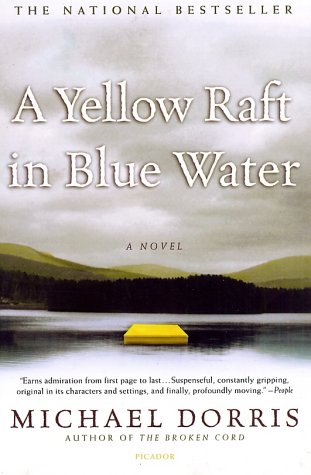
A Yellow Raft in Blue Water

Before we began to talk about the book, we spent close to 15 minutes talking about the author, whose life ended in suicide after being accused of child abuse. Kathy was deeply troubled that his wife, Louise Erdrich, stood by him which she felt made her complicit. We wondered how we would feel about reading her work again, as we had read both The Painted Drum and The Masters Butcher Singing Club in the past and had talked about maybe adding another one of her's to our list. Cheryl questioned if we need to like the artist to like the art. It's a good question. Welcome Diana - we are so glad you've joined our raucous readers.

That said, it didn't stop our group from another riotous book discussion. I was unable to find book club guides for this title. It appears this is taught at the college level and so there were plenty of essays and critiques, which means we pretty much just talked about the book and the characters.

We did like the way it unfolded the further you read. Some found Christine to be intolerable, abandoning her daughter as she did. Madelon, who grew up in Klamath Falls and with Klamath natives, said she was familiar with the privacy and secrets and the disinterest in owning material things as a way of life.

While it wasn't Aunt Ida's story, we felt that she was the thread that ran through it. Kathy recalled her saying, "I never grew up. I just got old." We shook our heads at all the secrets that the priests were required to keep, and especially liked Father Hurlbert who befriended Aunt Ida was continued to remain alienated after Willard Pretty Dog.

We contrasted Father Tom with Evelyn, the tough cookie who was the one who took Rayona back to her people after being abandoned by the priest. When Sky asked her why - because someone should have done it for her. Who acted as the person of Faith?!!

This was my third time to read this book and I've liked it better each time. Cheryl said that there was so much that she felt was going over her head that she will probably at some point read it again also, which is what happened to me! We wondered who would raise Rayona, who seemed to have found herself through Babe, the horse. Would it be Dayton who wondered if Rayona would like him? Would the half-breed raise the half-breed? I felt like Dorris meant some parallels between Babe falling in love and something that I was missing. Anyone? Anyone? Ferris??

We loved the forgiveness and peace that came to Dayton and Christine as her life was concluding. We couldn't decide what Dorris meant at the end of Christine's section when everything was so bright that she forgot she was wearing sunglasses. Was this her end? And speaking of Dayton, we questioned the relationship he had with Lee. Dorris certainly gave enough cues with the orderliness and aesthetic of his house.

Aunt Ida's section answers so many of questions and raises more. We all said we had to flip back to the section when Aunt Ida came to Seattle to see Clara in the hospital. Aunt Ida, who should have said no three time, had years of contentment with her children until Lee was killed. Would Christine fallen into alcoholism had Lee lived? How much of the rest of her life was driven by her guilt? So many "what if" questions around his death.

Next month we will be reading A Tree Grows in Brooklyn by Betty Smith.

Wednesday, June 9, 2010

Fried Green Tomatoes

Yesterday fifteen of us met to talk about this book and for over half of us, it was a re-read. We absolutely loved the book, loved the characters, the town and the setting. In fact, we concluded by saying that we'd like to read another of Flagg's books in the future.

It wasn't easy to pick a favorite character, but we leaned toward Evelyn Couch, just because of the way she stepped into her life and made it something she wanted it to be. That wouldn't have happened without Ninny so it was almost a draw.

Ninny was a fountain of words with a heart of love. Linda read one of her favorite passages from Ninny: "Now you ask me the year somebody got married, who they married, or what the bride's mother wore, and nine times out of ten I can tell you, but for the life of me, I cain't tell you when it was I got to be so old." This is typical bemused Ninny. She later told Evelyn that she was living on memories, yet there was nothing pathetic or particularly sad in this for her.

We felt that the small size and isolation of the town made room for Flagg's constructs: Idgie and Ruth - they could be openly accepted and embraced, though we were a little disappointed that Flagg hadn't developed Ruth more. We talked about race relations between Whites and Blacks in Whistle Stop and Birmingham. The high value of light skin was a player throughout the book, beginning with the twins and ending up with them not recognizing each other, because their color had sent them on such disparate paths.

We loved Dot Weems and her Weems Weekly - funny stuff - from the saga of Boots the cat (I hope you're satisfied) to the playful jabs at her other half. We thought Flagg very clever to show us their tender relationship though those short weekly installments.

We loved the conflicted relationship between Idgie and Sheriff Grady. He told her she couldn't feed the Blacks, then duty done, helped her masquerade as Railroad Bill by telling her the train schedules. The Dill Pickle Club was quirky - a liars' poker club. Many of the group had lived in the South and vouched for the big role of Tall Tales in Southern culture.

We thought it interesting that the Depression seemed to affect Whistle Stop so little and was a very slight part of the story, though were it not for the Depression, there would have been no famous barbecue and thus no secret for Artis to keep. Sandra read a passage describing how Sipsey buried the heads of all the animals she was going to cook because she said otherwise, their spirits would enter her. She wondered if Sipsey saw Frank as an animal.

We concluded by asking those who had seen the movie to tell us it how it compared with the book. We all laughed as they recalled the scene where Evelyn repeatedly rams the VW bug and says, "I'm older and have more insurance than you." Even though it was only two pages in the book, it apparently got promoted in the movie.

We concluded by collecting more suggested titles for next years reading. We are trying to think of some classics that we haven't already read too many times - put on your thinking caps.

Our final order of business was to elect a new time for future meetings. We will continue to meet the second Tuesday of each month, but with the library's new Tuesday hours of 12:00-8:00, we opted to meet at 1:00. It will be after lunch, so we can go for dessert and coffee if we'd like. Also, people won't have to stand outside, waiting for the building to open in unpleasant weather.

The dialogue was animated and I thank all of your for your contributions. I loved this book and came away with an even greater appreciation after the discussion. I wish I could remember more and hope you'll contribute your thoughts in the Comments section of the blog.

Thursday, May 13, 2010

The Chosen

What a discussion and in a respectful yet animated way, from 16 women. My mercy - who would have thought it possible. I apologize if I didn't acknowledge or make a place for your thoughts. Madelon has appointed herself as my spotter so we can make sure everyone gets a chance to speak who wishes to. It was a wonderful session and the credit goes to you all who have read the book, come prepared to talk about it, and then display interest with the others' opinions. And welcome to Barb and Rhonda and welcome back to Carolyn, ex-snowbird. Thanks for joining us and for participating in the discussion, even as newbies, well, not Carolyn, I mean not a newbie.

The discussion. Where to begin? First of all, we seemed to have been in universal agreement that we loved this book. I asked whose book it was and the answer was - it belonged to the four of them. Luci voiced early her disgust at the Reb's removed, silent treatment of Danny. Cheryl spoke of how she had seen that but came to appreciate the sacrifice that the Reb made because Danny was so smart but did not have soul, so necessary to be a tzaddik. Kareen mentioned that Danny could read a book at the age of four but laughed at the characters' misfortunes. She said she as a teacher had seen how impatient really smart kids could be with students of normal development.

We also acknowledged that Danny would have gone on to be the tzaddik, but his father knew his son's heart, even if he didn't talk to him, and began the free-Danny stage by letting him enroll at Hirsh Seminary and University. Many of us were of a mind with Luci, that the Reb was a hard father, but she and all of us began to appreciate through the discussion that he was also a compassionate man. So much of the Reb was brilliantly exposed through David Malter in his discussions with Reuven. I think we agree that David Malter was our favorite character. And then how about the Reb's conversations with his son through Reuven?! This was a coming of age story, at the most simple level - a story of love and developing relationships, but the interplay between the fathers and sons made it coming-of-age story on steroids.

Something we might want to think about for the future is the sharing of favorite selections:

Linda chose the last page, when David Malter asked Danny, "When you have a son of your own, you will raise him silence?" "Yes," he answered. "If I can't find another way." How strong the parent's role is and how likely it will be replicated. Will it?


Cheryl shared this selection: "We are as easily degraded as any other people. That is what happened to Polish Jewry. By the eighteenth century, it had become a degraded people. Jewish scholarship was dead. In its place came empty discussions about matters that had no practical connection with the desperate needs of the masses of Jews. Pilpul, these discussions are called - empty." How so contemporary.

I chose (because I can remember) this selection from David Malter: "I only wanted to tell you that I am doing things I consider very important now. If I could not do these things, my life would have no value. Merely to live, merely to exist - what sense is there to it? A fly also lives."

Leslie recalled the trapped fly in the spinder's web, released to be a fly. She saw it as a parallel to Danny's entrapment in the tzaddik role and then being freed. We also talked about the title - The Chosen. The response was overwhelming that it was the perfect title, starting with the Jews as the Chosen People, to Danny's path to tzaddik to Reuven's life as a Rabbi.

We were so lucky to have been joined this month by Barb, whose roots are New York and Jewish. She filled in so many gaps for us that I'm am not competent to supply here. She was like having a living commentary - thanks Barb, for being so game. I know I've said this before, but this was the best book group ever.

Thursday, April 15, 2010

A Prayer for Owen Meany


We had a record-breaking 15 in attendance at Tuesdays book club meeting. We needed four tables to accommodate everyone. Welcome to Sondra and Darlene! Please note that the list of books we will read for the remainder of this year appears in a column on the left side of this page.

Luci asked me how we select books. All the books are titles that have been suggested by members of the group. We can begin to compile a list of suggestions for 2011 at any time, though we do need to submit our completed list to library administration in October. They require two months prior notice for the Calendar of Events, but I like to have the whole list since we can harvest from book donations if we know in advance what we will be reading.

It would be impossible to remember the discussion yesterday. I do want to add that a later edition had a afterword from the author in which he said: As for Vietnam and all the rest, I take Johnny Wheelright's view of the 1960's - "precious little irony." And I take Owen Meany's view of the television; it seems even truer now. Much of the self-seriousness and lunacy is in Owen's words, "MADE FOR TELEVISION." We felt that Irving gave John Wheelright his own name to punctuate that these were also his opinions.

We didn't enjoy reading Owen's dialogue in all caps but agree that it certainly did get the point across that his voice was different. Cindy had listened to it and said that the reader used a high pinched voice to deliver the strangeness of Owen's voice. The book is extremely layered, both as a Christ story and and as a vehicle for Irving's political opinions. Irving admitted in the afterword to not being a religious man, yet Owen's story is strongly religious. Cheryl has read this book five times and suggested that Irving intended John Wheelright to represent John the Baptist. John existed in Owen's shadow and felt he was nothing in his absence. John was still a virgin, eschewing women and taking on a form of monastic life, even going to Katherine Keeling's island (Patmos?).

Madelon said that she read Irving doesn't start to write a book until he knows what the last line will be. We thought it was remarkable technique and wondered how he developed this story from "O God - please give him back! I shall keep asking you." We felt Irving's device to deliver his political views was very effective, using his contemporary life in 1987 Toronto, to parallel Viet Nam to the Reagan administration in an effort to demonstrate how "above the law" they all behaved. Many of us remember that era and felt the author's rage.

We all agreed that the first 300 pages were demanding and hard to get through and that the second half of the book is where the action is. The four that had given up on the book said that they would have to reconsider and maybe finish it after all.

In spite of the large attendance, the discussion was animated, respectful and flowed well. Eight people went to lunch at Pinocchio's afterward, which is what the size of a normal book club meeting usually is! I think the book itself drew a lot of people. It was a re-read for many of us, a book we remembered fondly. Let's see how The Chosen fares next month~

Friday, March 12, 2010

The Pillars of the Earth

We had an interesting group of ten this week. There are about 20 names in the email group, yet we almost always have 8-10 people - just not the same ones. We were delighted to welcome Luci, who joined us this week.

We talked over the longest book we've read in the shortest discussion time and were in agreement that a shorter book might have been a better book. It was very readable and there was no one who did not like it, though there didn't seem to be any unanswered questions by the time the book was closed which didn't give room for directed discussion - not that we lacked for things to say.

Mr. Follett has a reputation as suspense fiction author, but he has a personal passion for cathedrals and their construction, and in this book, he brought the two things together. He has been criticized for using 20th century thought and language in a 13th century setting. We talked about it and couldn't help but think that it was a deliberate choice to appeal to his established audience. That construct has met with mixed approval. It's hard to argue with success since this is his best selling book. I was one of those who struggled with contemporary trendy language. "Get. Out. Of. Here." That bothered me..

We also felt that he could have moved the pace faster if he had reduced the amount of internal dialogue. When young Jack set fire to the church ceiling, the pace that should have been breathless was instead glacial, as he provided us with every thought and misgiving that crossed Jack's mind.

Favorite character? I think it was between Ellen and Prior Phillip. If you weren't there, please tell us what you thought.

Wednesday, February 10, 2010

East of Eden

Yesterday nine intrepid book lovers came together to deliberate the merits of the book John Steinbeck considered his opus, and Kathy was quick to agree with his assessment. Welcome to Jan and Cheryl - thanks for joining us. I find it remarkable that each month we almost always are an assembly of nine, just not the same nine - a supreme court, of sorts I suppose.

We were quick to agree that Sam Hamilton was our favorite character, closely followed by Lee. The serpent was Cathy/Kate with her little mouth, sharp teeth, pointed darting tongue and small, lobeless ears close to her head. Who was Eve? The book is rich with symbolism and we had a lot of fun sharing the things we had already uncovered and discovering things we had missed. We thought that Cain and Abel were both Adam and Charles and Caleb and Aron.

Just what or where was Eden? Kareen and Cheryl talked about the garden that Adam had planned to build but didn't, or was it the Salinas Valley, which would then place the Trask place to the east of it? And who was Eve? We couldn't decide. Was it Lee? We loved Lee's theological discussion with Sam over the Genesis story, and Timshel - thou mayest, and Steinbeck's use of it to close the book.

Abandonment is key to the story - all these people left to figure things out on their own, children without mothers and absent fathership. Cal tortured himself that he was the son of a whore, but didn't get much sympathy from Abra whose father was a thief. Cal said, "but I've got her blood," and Abra said, "I've got his." "They walked along in silence while he tried to rebalance himself." We felt that Cal and Abra would go on to a healthy, and probably the only whole marriage in the cast.

It was painful as I read to realize that for the story to follow the allegory, Cal had to be responsible for Aron's death in some form because I just liked Cal better. Aron was withdrawing from the real world and living in a world of his own making, much like his grandfather, Cyrus. I can't remember who pointed that out. Abra complained that Aron didn't know her, but was making her a virtuous woman, an untruth.

Speaking of truth, Sheriff Quinn said, "Adam could do no dishonesty." We talked about the fact that he rejected Cal's money as ill-gotten gains, yet lived on his father's ill-gotten inheritance. No one liked Adam and we were reminded that before he got his money, he was a hobo. Kathy decided that he was just lazy and without the money, he probably would still be a hobo. We wondered what was going to happen to Kate's ill-gotten money, which she left to Aron. And why only to Aron, not Cal? Several asked, did they have two fathers? Sam pointed out that there were two sacks.

We thought about maybe putting a Steinbeck on next years book list, but Kathy begged us to rethink that. She says she has enough of him for now, having read four in the last couple of months. Kareen suggested she try "Travels with Charlie." We might want to think about that one for next year. We did change the September book from The Rule of Four by Ian Caldwell to The Women by T.C. Boyle and I have changed that in the reading list for this year that I posted in an earlier blog. Please feel free to add your comments.

Wednesday, January 13, 2010

Plainsong

We welcomed two new ladies this month, Cindy and Kareen, and for the first time ever at Jenny's suggestion, started with introductions, something that was long overdue. Ironically, it seems that almost everyone has been a teacher at one point or another. Do all of us own cats too?

We loved this book, loved it from the book title play on words to the open ending, where the characters who have stayed true to their principles face a murky and unclear future. Principled principles?? As Madelon said, the writing was remarkable as much for what wasn't said, as for what was.

Considerable discussion took place around abandonment: Guthrie's preoccupation with his own difficulties, the withdrawal of Ike and Bobby's mother, Victoria's mother locking her out of the house and her life, and the orphaning of the McPheron's at an early age. We questioned if the Beckman's violent home was a form of abandonment of their son.

Linda said when she taught at the juvenile detention center, they often wondered what made some children survivors and others not. Certainly, Victoria was a survivor and wise beyond her years. Why her and not the Beckman boy? And much of the story was determined by the time in which is was placed and the small town locale.

So little is known about the characters outside of this six month period. We don't know what happened between Victoria and her mother earlier. We felt that Tom Guthrie was a good man, even though he had been vague as a father in this pastiche. Maggie was our favorite character, and we can only determine that Tom's daliance with the secretary was because he felt he didn't deserve Maggie, something he told himself in the mirror.

We were thrilled to have a story that flowed through so few characters. It read so easily, it seemed to be a simple book, which it certainly was not. We loved the McPherons and their taciturn manner of speach. I said I could see Robert Duvall playing one of them in a movie, because I had seen him in a similar role. That movie was Tender Mercies and it won the 1983 Oscar and he the Oscar for best actor - little aside there. The parallel lives of the McPherons and Ike and Bobby was deftly woven through the narrative, yet not overworked.

I hadn't checked my phone after I got to the library and had received an email from Leslie, explaining why she wouldn't be able to make it. Below are her notes - I thought you would enjoy hearing from her.

"I enjoyed reading Kent Haruf's Plainsong. I like how it took turns with the characters and then ends with the chapter entitled "Holt," the town, yet that chapter isn't about a small town. A small town is the sum of the people living there and so "Holt" brings all the main characters together and now a family of sorts, yet perhaps the best kind of family in this dysfunctional society.

Many of the scenes are really vivid, slices of life--so realistic we become flies on the wall, watching what's happening to the main characters. And there's some great dialogue, especially from the two McPheron brothers, Raymond and Harold. I love when Harold and Raymond squabble over Harold's comparing Victoria to a heifer and also when the creep in the convenience store gets his pack of gum and tells Victoria to not work too hard after he's scared the heck out of her with his crazy talk about killing himself, the dog, and one of the gals working at the convenience store.

Also, some could argue that everything seemed gift-wrapped and tidy at the end, yet it really isn't. Guthrie may get fired, and he has no idea what he'll do (except not farm); his sons, Bobby and Ike, have experienced a lot of trauma at [e.g., deaths (horse and Mrs. Stearns); the really scary kidnapping; the physical and emotional loss of their mother]; the McPheron brothers still will lose Victoria and her daughter at some point, so Victoria can go to college, although we think, even when that happens, she and the baby will be back to visit if not to stay; and Maggie's father will die. Life will go on in Holt."

What she said~