Tuesday, July 17, 2012

The Postmistress

We really liked this book. There were several themes, but we felt the key theme was randomness - the randomness of everything. Mary read the passage where Frankie ranked all the random occurrences using the word if, and then made the word if into a single paragraph.

Cathy and I both felt bad for Harry's ending. A review for Entertainment Weekly said, "The ending is a bit of miss. One final tragedy seems unnecessarily cruel. But in a novel about war, perhaps that is the point."

The title would lead you to believe that the book was about Iris James, but it was really Frankie Bard's story. Both Cathy and I didn't realize the introduction was Frankie speaking - we thought it was Iris, and that led to a false start. The two did share a transgression however. They both had a letter they withheld. Iris's entire life was about structure, order and following rules so this was uncharacteristic for her, as uncharacteristic as chopping down the flagpole.

Frankie also withheld a letter but with the intention of delivering it personally. It was never delivered and that was uncharacteristic for her as she had espoused telling the truth as it appears. Her experience and helplessness in trying to record the voices of Jews being round up produced what Cathy called shell shock. Her desire was to get people to pay attention. She says to Will, "Whatever is coming does not just come, as you say. It's helped by people willfully looking away. People who develop the habit of swallowing lies rather than the truth. The minute you start thinking something else, then you've stopped paying attention - and paying attention is all we've got."

She wanted people to see the story and everything and every assignment was to produce a result. The train ride left her desperate - all that record of death of people she had just met. Recording their voices went no further than her until Otto in Franklin. She wanted people to respond and when it didn't happen, came home to recover, get her bearings and deliver the letter. Cathy thought she should have steamed it open to realize that it was a loving message, but Wilma wasn't so sure. That would require her to reveal that Will felt fulfilled in London and wasn't sure he would go home. And then he stepped into the street, looking the wrong way. If.

From the beginning of our discussion today, Cathy was flummoxed by the title. Why did Blake choose to keep this one after she learned that there is no such thing as a postmistress and especially since this wasn't a story about Iris James, the postmaster of Franklin. Carolyn wondered if perhaps Blake left her working title in place to cover both Frankie and Iris as carriers of withheld letters, both postmistresses.

We talked a lot about hows news was delivered and received during this emerging technology of radio and compared it to the instantaneous and ubiquitous news of today. We asked if more information causes people to be any more engaged then when they relied on a single broadcast. Mary told us how frustrated her son is in Afghanistan where American troops are being fired on by the very army they're tasked with training. This conversation continued for at least a half hour, but because it wasn't far from the points that Blake had raised, there were several call-backs to the book.

I thought about the book on my way home and realized that the strong characters were so strong that they dominated our conversation. I think we missed something by not evaluating well-educated Emma and Will, both weak and lacking confidence, in contract to Jim and Maggie, of the fateful baby, who lived simply yet purposely.

I always say I don't like historical fiction but this is one of my favorite books in a long time. A reviewer from Library Journal said, "Verdict: Even readers who don't think they like historical novels will love this one and talk it up to their friends. Highly recommended for all fans of beautifully wrought fiction." I agree!

Tuesday, June 12, 2012

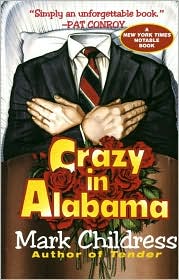
Crazy in Alabama

I believe this was the shortest discussion we've ever had on a book before. We enjoyed it but the consensus was that it was two books woven together and that they would have enjoyed reading them as two separate stories. I was the only one who felt that the antics of crazy Lucille helped make the harshness of the racism easier to read.

With the exception of Joanne, we wanted her to get away. Kathy said, after all - she had paid the judge, which made us laugh. Kareen pointed out the ending, which I had missed, and I thought was a fitting conclusion. She essentially threatened PeeJoe, reminding of what happened to the last man who said no to her.

Joanne was appalled that Lucille went scot free when Dove paid such a heavy price for the stand he took and the responsibility he carried. His wife left him, his daughter developed schizophrenic, he lost his house and business - everything. Kareen said she assumed when he sent the postcard saying he had gone fishing that it meant he intended to off himself.

The rest of our discussion had nothing at all to do with the book and I enjoyed it very much.

Tuesday, May 8, 2012

Falling Leaves

When I was reading this, I wondered how it would be possible to have a discussion on a nonfiction book, but we did and it lasted an hour. We enjoyed the Chinese history but Kareen said that was the only part she liked. She and Maureen were both griped that Adeline continued to allow herself to be used by her family. Kareen thought that if they came to her for assistance even today that she would give it.

We realized that the Chinese culture dictated the families behaviors and relationships somewhat, but there were those like Susan and Aunt Baba who were able to break away. We didn't understand why Father treated Yee Yee like he did, which is so counter to their custom of deference to elders. Joanne had the sense that writing this book was a form of catharsis for the author.

Niang was cruel and as Dianna said - evil. Joanne called her pathological. The power she held was mind-bending and at the heart of this autobiography, power she wielded ever after her death. She wanted to break Adeline and was never able to do it, so she cut her out of her will as her final blow. Carolyn joked that this was a fine Mother's Day book.

Maureen thought that medicine was one of the few fields in higher education that a woman at that time had open - be a doctor or be a teacher. Kathy noted that as obedient as Adeline was to Father, the only thing he wanted was for her to return as a gynecologist and practice in Shanghai, which she never did. She also marveled at how difficult it was to be a minority woman doctor at that time in London, yet she did it.

When Adeline had experienced so many awful things, I asked what one thing was the worst and they all agreed it was the duck. The one thing that she loved was brutally taken away. I wondered if they sent Adeline to school behind the Red Army lines, hoping that she would disappear.

We talked quite a bit about Catholicism and the family's conversion to it, what it contributed to them or didn't. Wilma didn't have the feeling that they were religious, but they did want to send their children to the upper class private parochial schools. We wondered if they hadn't converted, would the story have played out the same, and then we chatted a bit about Buddhism. We concluded with mothers and nuns in the schools.

Tuesday, April 10, 2012

Honk and Holler Opening Soon

We universally liked this book.  Joanne said that her favorite part was the characters, they just jumped out of the pages at her.  We must have agreed because our discussion centered around the characters, what we liked, things they did and said and what we enjoyed.  Mary said that she has family from Oklahoma and she felt like this could have been from them.

We liked how no one owned much of anything, yet they made such a difference for each other, creating a family of sorts with the cafe at the hub.  Joanne laughed, saying that the title didn't just apply to the cafe, but also to the people it attracted.  They seemed to bloom, were opening up, when they came into the cafe community.

I struggled with Sam Neely because I felt his demise was just a little too tidy, eliminating him and his treat from the circle of friends.  Kathy thought it would be poetic justice were he to become a paraplegic, confined to a wheelchair like Caney. 

The one area we all had a problem with was Helen.  Mary didn't get the whole Helen thing, and Maureen agreed, saying she hadn't furthered the story for her.  We saw the need for a Helen-like element, to motivate Vena and keep her striving for something outside herself, but the elements of their story were disjointed and confusing.  The ending was as bewildering as the story and the timeline was unclear.  Carolyn thought it was mighty coincidental that Helen had been to their old house a year earlier and Vena just happened to stumble upon it the following year and also find the note that her sister had left her.  Kathy was incredulous that given their history and how hard Vena had struggled that she didn't keep the note.

That said, it was a delightful book, and as Kathy said, it reminded her of Fried Green Tomatoes.  We agreed that the hard work we invested in this list has paid off for the fourth month running and we have started jotting down titles to consider for next year.

Tuesday, March 13, 2012

Stones from the River


It was nice to finally have a book to talk about that we had all enjoyed and felt strongly about.  Both Carolyn and Diana came with notes and the rest of us marked up our books - sorry library - I'll get those marks erased and the book returned this week.  I think I had marked at least ten pages and many of the things we talked about were noted by all of us.

Even though published 25 years ago, we felt the book had a lot of social relevance to America's current political climate.  Leo observed on a couple occasions that the Germans were looking for a one strong leader who could make you obey...Who tells you:  This is the right thing to do." Hegi uses Leo's observations as balance to all the people who think the Fuhrer will bring Germany back from it's humiliation from WWI.  Carolyn had noted Leo's observation that "they lived in a country where believing had taken the place of knowing." 

Hegi took the narrator's license at times:  "They didn't know that they were giving their power away, didn't know that - by the time the Nazi regime would become bloated and monstrous with that power - it would be too dangerous for the people to reclaim that power."  She allowed Herr Abramowitz to tell his wife that her ability to adapt" is far more dangerous to you than any of them will ever be.  You'll keep adapting and adapting until nothing is left," and many of her characters weighed in on what their silence and acceptance had cost them.

Kareen said this was the first time she could remember reading about the Holocaust from the German perspective and felt it provided a new perspective to the genre.  That was the setting for what Mary, Kareen and Joann all agreed on was a book about differences, acceptance and community.  Diana had marked "it was amazing to discover how many reasons other than size could turn you into an outsider - your religion, your race, your opinions."  We wondered if in reality Trudi would have escaped the camps and Joann said that when she was arrested at the concert, she was certain that was where Trudi was headed.  It's impossible to synthesize such a complex book but we did think that Hegi chose a Zwerg as her protagonist as a parallel to the Jewish otherness.  Frau Abramowitz told Trudi that it's important to never lose your dignity because it meant a loss of dignity if she rebelled against authority, while to Trudi just rage carried its own dignity.  We saw rage as her armor as well as her dignity.

Trudi's strength of character came from her ability to step over the loneliness and hurt she experienced.  Max told her that what she was is what made her who is was.  He saw the pain that she had locked away and when Trudi tried to compare Max's pain he stopped her to say, "Ah, but we can't do that - compare our pain.  It minimizes what happens to us, distorts it.  We need to say, yes, this is what happened to me, and this is what I'll do with it."  I thought he was referencing what he knew to be the hurt she had locked away.  Mary said she had taken it a completely different way.  When she had experienced a medical crisis, she downplayed the event and minimized it, reducing her family's ability to engage in what had to be a fearful time for them as well.  I'm always fascinated by what a book speaks to different readers and it's why I love literature.

Mary also wondered if Hegi gave us Max, even though he was the least authentic character to us so that it would soften Trudi's load and make the book not as heavy.  As Kareen noted, he wasn't around long enough to really be much of anything, though he did live on in the story of the naked man by the river.  We liked the title name for the stones, the river and the freedom that Trudi was able to experience when she was released from gravity while swimming.

Mary started the discussion by saying that she loved the entire book but the last four pages confused her  - she wondered what the author was saying.  Kareen had marked a selection at the end that had spoken to her - about raking - and said it's what she had taken away.  Trudi's father had raked the earth behind the library every week and she had learned from him that raking had to do with patience. not every bit of earth would be untangled at once.  She decided her life and the people who loved her stories would be like pulling a rake through the earth.  "The final design wouldn't happen all at one: there would be rearrangement of it all, a fine combing through: there would be perseverance and a reverence for the task.....indeed, a design would emerge."

Several of us said that this would probably go in our top ten, along with Shipping News.  And a good time was had by all~


Tuesday, February 14, 2012

A Tale of Two Cities


I get the book cover images for our blog posts from Google Images. This is the first time that I've been swamped with cover images - that's how many imprints this book has had. The library had a display in the entry celebrating Charles Dickens 250th birthday and it was just by coincidence that we had chosen to read Dickens this month. They guestimate his birthday to be February 7, 1812.

We chatted for a bit and then Mary asked if she could speak to the book before we began our discussion. She apologetically acknowledged that she had been the strong supporter of this title, and had spend a ghastly number of her pennies on this vote. She said she read the first 100 pages, and then realized that she didn't understand them, so read them again. She said that she felt like she had nominated another Salmon Rushdie, and I had to laugh at that since I'd felt this to be our second most challenging book after Midnight's Children.

I had the pages I printed from Wikipedia to help me understand that time period. Mary was relieved to hear that we all felt enriched from reading this book, even though it was a challenge. I said that I would never think the French Revolution in the same way again - the desperation! Talk about the 1% and the 99%!!! We talked about La Boheme and Les Misérables, also artistic depictions of the desperation in France before the Revolution. Carolyn made me laugh when she likened the small circle of coincidences to Downton Abby. Mary loved the tension at the end when Madam DeFarge was marching toward her goal of eliminating all Evrémondes and Miss Pross's determination to stand in her way. The tension was brilliant.

I would never have started or finished this book without the expectations of our discussions. Thanks for pushing me outside my comfort zone. It wasn't easy but it was good.

Tuesday, January 10, 2012

A Dog's Purpose

This was the most unusual book club meeting we've ever had, since there really is nothing to develop a discussion around. We did have discussion around Senora's comment: "There are no bad dogs, Bobby, just bad people. they just need love," to which Bobby replied: "Sometimes they're broke inside, senora. And nuthin' will help 'em" We talked about that in the context of Todd and a number of us said that Todd reminded us of the movie, "The Bad Seed."

We just talked about the book as we remembered it, and the things that we liked - we laughed a lot, though we all admitted to crying at different points in the book. We also talked about what the dog(s) learned over four lives about purpose: to love, comfort, find, show and save. It was more conversation than discussion and it lasted two hours. The conversation migrated into story telling and more laughter.

We were twelve today, the largest we've been in a long time. The discussion remained round table in spite of the large group, a quality of our group that I admire very much. Ultimately, we started talking about e-readers as there were six present, and were Kareen not on vacation, it would have been 13, pushing us over the 50% mark. Cathy laughed at us, remembering the conservation a couple years back when we all cringed at the thought of not reading in paper. Today Joann was asking for our feedback as she is interested. We all jumped in, telling her about about easy it is to check ebooks out from the library. Cathy is right. We have certainly changed our tunes.

We thanked JoAnn for recommending this book for January, as it was just what the doctor ordered after the chaos of the holidays. She also reminded us that we're reading A Tale of Two Cities for next month and to get cracking!